Giving
Gifts in kind: Defining giving differently
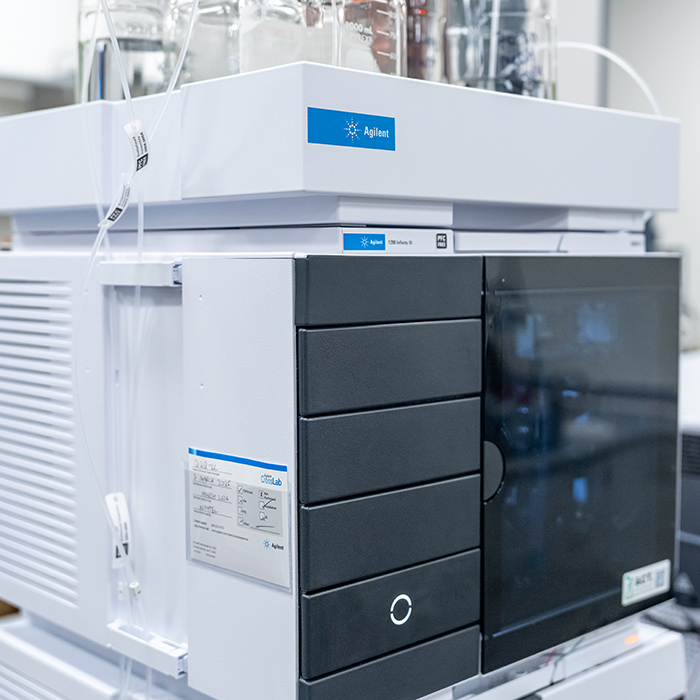
The Jess and Mildred Fisher College of Science and Mathematics received a liquid chromatograph mass spectrometer, a $444,250 gift-in-kind, from Agilent Technologies Inc.
Research is taking place in TU chemistry professor Ryan Casey’s laboratory related to per- and polyfluoroalkyl substances (PFAS), commonly referred to as forever chemicals, used in a variety of industrial applications and consumer products. PFAS are widespread in the environment, contaminating drinking water and circulating in the blood of almost every person in the United States.
“As a society, we are early in the learning curve regarding the impacts of these chemicals,” says Casey, director of the environmental science graduate program.
“Agilent has supported our academic mission to include students in the learning process. From the initial inquiries about this instrument through installation and training, Agilent has been an excellent partner.”
Ryan Casey, professor and director of the environmental science graduate program
The analysis of PFAS requires extremely sensitive measurements because, even though concentrations are low, their presence is significant enough to be biologically relevant.
A triple quadrupole mass spectrometer is the gold standard measurement instrument and an important investment in the TU student research experience. The recent gift-in-kind from Agilent Technologies, Inc., valued at more than $444,000 and combined with nearly $400,000 in university funding, made the purchase of this critical technology possible.
“Agilent has a generous history of gifting equipment to other universities, and I thought, ‘Why not at TU?’” says Science Complex building manager Josh Wilhide, who first learned of the Agilent program and negotiated the deal.
“Agilent is very committed to enhancing the student experience—better preparing them for careers in STEM fields,” says Jim Lynch, director, business development with Agilent. “Agilent routinely does this type of gifting, especially for new teaching labs and STEM buildings.”
Both graduate and undergraduate students have been using the mass spectrometer since the day it was installed in March 2025. As the name forever chemicals suggests, PFAS aren’t going away. The skills these students are developing are highly desired and make them highly marketable as they enter the workforce.