Podcast
Three Degrees: The Life-Changing Shift of Parenthood
Graduate students balance family and education.
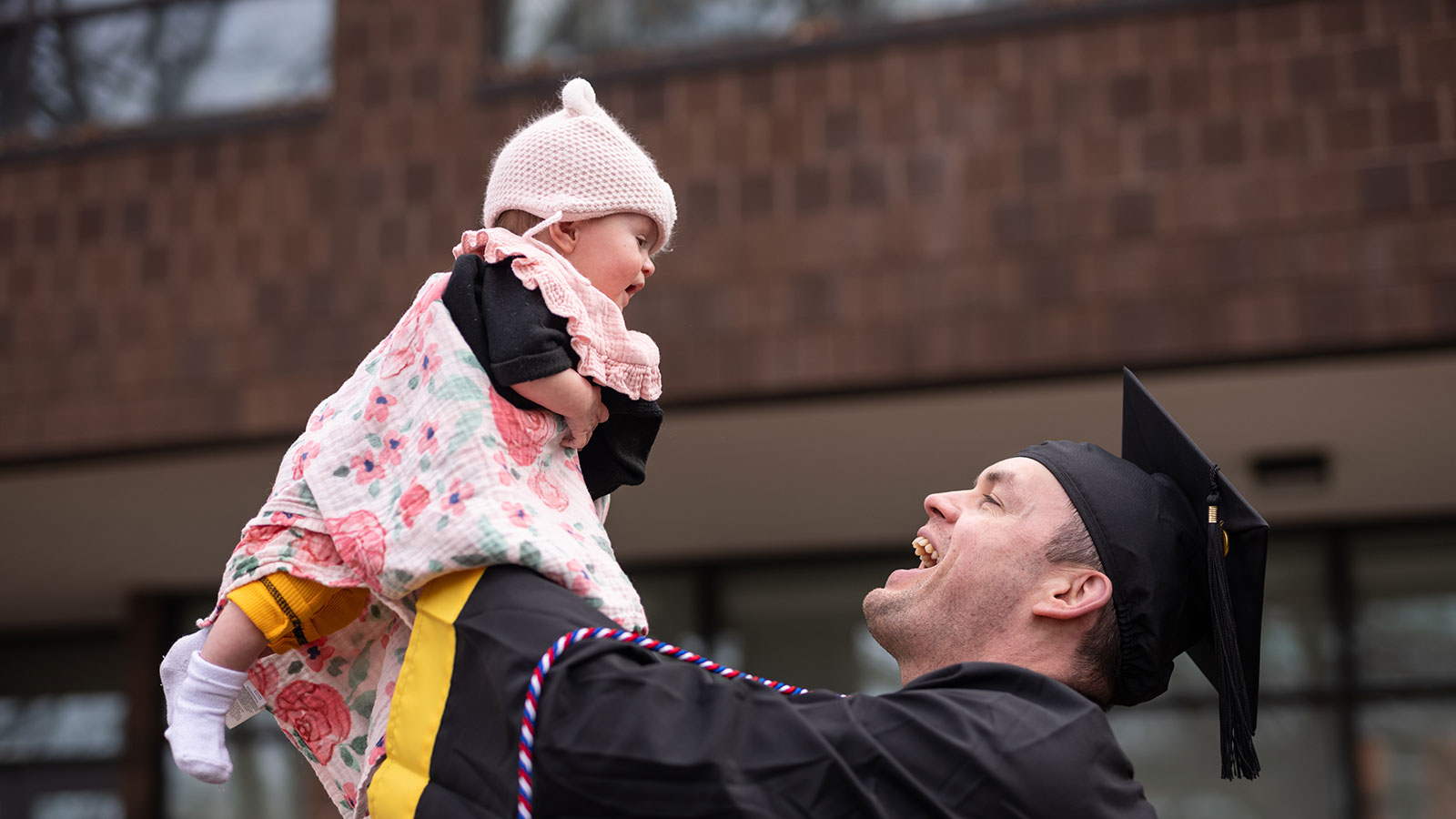
Parenthood changes everything—when you wake up, when you sleep, when and what you eat, how you spend money and most importantly, how you spend your time. For graduate students who are also raising children, that shift can feel even more profound. At Towson University, student parents are proving that while raising kids and pursuing higher education isn’t easy, it’s possible with determination, resilience and support.
Ahmed’s Story: From Uganda to Towson
For Ahmed Satti, father of four, graduate school was not part of his original plan. But when he decided to pursue a master’s degree in geography and environmental planning, his first challenge was simply getting to the United States.
Ahmed, who is Sudanese, was living with his family in Uganda, and applied for a visa both there and in his home country. He soon learned that the embassy in Uganda had a two-year backlog; fortunately, he was offered a visa appointment in Sudan. “So I had to leave my family, um, not knowing if I would get the visa or not,” he recalls. “And also the fact that we're not from Uganda, having to close down the whole house. So I left all of that for them in Uganda” Luckily, the risk paid off—he received his visa and reunited with his wife and children in the U.S. a month later.
When you make your children your priority in life, everything falls into place.
Ahmed
Still, the transition wasn’t easy. “Back home you have this, um, support network,” Ahmed says. “Everybody has a nanny, everybody has a driver, everybody has a gardener. And then now to come and it's like you wash your own dishes, you have to cook. I have to do all the drop offs and pickups…it’s just a lot.”
COVID-era online classes added another challenge. Ahmed remembers trying to focus during a Zoom lecture while his daughters practiced gymnastics in the background. “One of them, like, fell and knocked stuff over,” he laughs. “At the moment it was like I was really pissed off. But like later on, it was funny.”
Despite the chaos, Ahmed has gained clarity. “My kids are the most important thing in my life,” he says. “When you make your children your priority in life, everything falls into place.”
Chrissy’s Story: Pregnancy and Graduate School
For Chrissy, graduate school and motherhood collided in real time. “I found out I was pregnant in October of 2023, and I started my grad program that following January,” she recalls. “This was all part of my master plan about how I can do everything. Sure. Why not? You know, be pregnant and start a master's program and go on maternity leave and have a three month old - like, “that shouldn't be hard” is kind of what I was telling myself. Uh, yeah. It turned out, you know, sometimes true, sometimes not true.”
Chrissy and her husband both work full time while raising their two-year-old daughter. For her, the key has been to prioritize intentionality. “Making sure that we carve out time for us, making sure that we carve out time for our daughter, making sure that we carve out time for our friends and our family,” she says. “I think a lot of times, like it ends up being maybe less actual time that we want it to be, or that we would hope for, but because we're being more intentional about the time that we're spending, and the kind of the value of the time is greater.”
She uses a simple framework to balance priorities: glass balls and rubber balls. “The glass balls are things that like, if you were to drop, they shatter,” she explains, “whereas rubber balls are things like, yeah, sure, you might drop them, but they'll bounce back up.” When her daughter came down with hand-foot-mouth disease just after Chrissy returned to work, she knew what mattered. “That was a glass ball,” she said. “I had to go immediately to daycare, take her to the doctor, pick her up. But that meant that, like, work. Yeah, sure. It'll be there. It'll bounce back.”
Yeah, I think the, the, the biggest lesson is that, like, you can't do it all to the level that you want to do it…I’ve really learned to lean on other people.
Chrissy
But Chrissy admits she couldn’t do it alone. Her husband’s demanding schedule as a CPA means they often rely on family support. “Oftentimes we have to use our community,” she says. “I like to think about it as the time that my daughter is like spending away from us with other people in our in our village, if you will. Is that, like she's getting to build those bonds with those people.”
Asking for help has been a learning curve. “I hate…feeling like a burden,” she admits. “But I've learned that, like, most of the time, people are more than happy to kind of be reached out to… And so I've really learned to lean on other people as much as I might still be reluctant to do it. Um, I do know that, like, it one helps me. It helps them."
Christina’s Story: Choosing Family First
Not all student parents take the plunge immediately. Christina, a teacher and mother of three, postponed graduate school until her children were older. “Graduate school came later for me after I homeschooled my children...[and] supported my partner’s career,” she says. “By the time my children were around 12, 10, and I think 8…I went back to graduate school.”
Her children were proud cheerleaders. “At that age, they believed in me completely,” she recalls. “They thought I was smart and could do anything. That support meant everything.”
But Christina’s path was shaped by difficult choices and limited support. As an undergraduate, she had been encouraged toward a Ph.D.—until she got engaged. “Some of my professors…said they would not be able to write the same letters for me that they would have been able to write prior,” she says. “One professor said that they felt that I was, um, just going to get married and have kids and that it wasn't going to work.”
Sometimes you have to make a decision for yourself and for what you know that you need. Even if you don't have the support.
Christina
Though she was accepted into a few doctoral programs, her partner wasn’t supportive of relocating or delaying his own career. “He said, you know, when the kids are older,” she recalled. And several years later when she asked again he basically said that he liked me being in the supporting role as wife and mom.”
Ultimately, Christina decided to pursue her degree anyway—on her own terms. “Sometimes you have to make a decision for yourself,” she says. “Even if you don’t have the support." A graduate assistantship covered her tuition and allowed her to move forward.
Building Support Systems for Student Parents
While each parent’s story is unique, their challenges reveal a common need for strong support systems. Kimberly Mocombe, project coordinator for Towson’s CCAMPIS program, sees this every day.
CCAMPIS, a federally funded grant, provides resources like childcare subsidies, textbook and Chromebook loaner programs, and even a family study room in the library.
“If you don't have a support system and you are unable to pick up your child from school or childcare or whatever, what are you supposed to do?” Mocombe asks. “People are trying and they’re trying earnestly…Don’t punish them. Don’t make it harder.”
CCAMPIS, a federally funded grant, provides resources like childcare subsidies, textbook and Chromebook loaner programs, and even a family study room in the library. But Mocombe stresses that the greatest value may be simply connecting parents with one another. “A lot of student parents, um, they feel alone,” she says. “It’s important to connect with a community, with other moms, with other dads, um, with other guardians.”
Redefining Possibility
Parenthood may change everything, but as these Towson University students prove, it doesn’t have to mean putting dreams on hold. Whether juggling toddlers during Zoom classes, balancing glass and rubber balls, or returning to school later in life, they show that education and family can grow together.
This summary narrative of a TU original podcast titled "Three Degrees" was created with assistance from artificial intelligence.
About the series

The Three Degrees podcast series dives deeper into the lives and experiences of Towson University graduate students, exploring what sets them apart — and more importantly, what brings them together.
Three Degrees is available here and on: