Giving
Gifts in kind: Defining giving differently
The College of Health Professions received a $25,367.67 gift-in-kind from USA Lacrosse Center for Sport Science and Safety.
In March 2025, nearly a decade after kinesiology students had the opportunity to train on GPS monitoring equipment as part of a collaborative research project with TU Athletics and Walter Reed Army Institute of Research, USA Lacrosse gifted sport performance tracking (SPT) equipment valued at more than $25,000, to the kinesiology department at Towson University.
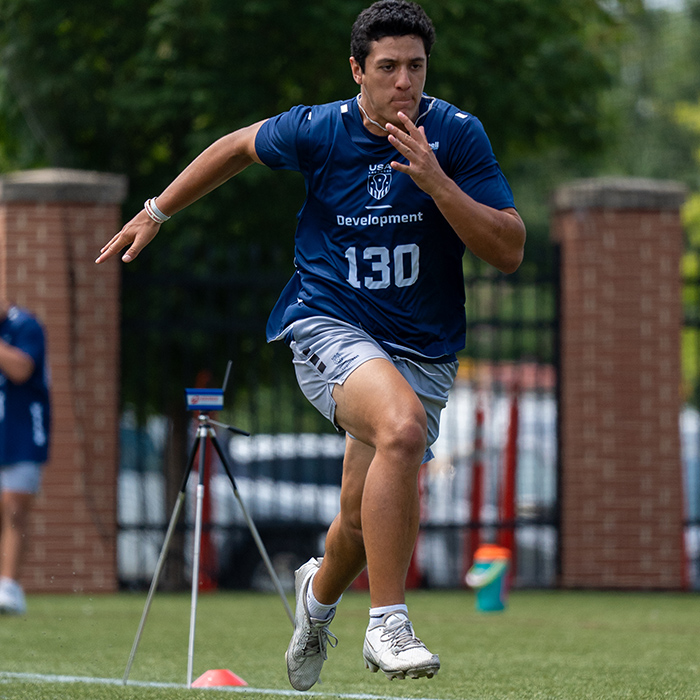
The equipment helps coaches, support staff, athletic trainers, strength and conditioning coaches and sport scientists to evaluate the fitness of players as well as the demands of training and competition. In total, 75 vests and 45 GPS units, along with charging docks, heart rate monitor clips and chest straps, were gifted to TU. The GPS monitoring vests measure variables including heart rate, running distance and intensities.
“These tools mirror what our national teams use, bridging classroom theory with real-world application,” says Bailey Speight, USA Lacrosse’s sport science manager for men's and women's national teams. “At USA Lacrosse, we’re committed to not only grow the game but to advance athlete safety, performance innovation and evidence-based best practices nationwide.”
“We are very fortunate to have a strong relationship with USA Lacrosse. Not only have we received valuable research equipment, but our kinesiology students also had experiences which resulted in internship and career opportunities.”
Kyle Leppert, clinical associate professor, kinesiology
At one time, technologies like SPT were only used in professional sports. The evolved technology is now present across all levels, including youth sports. As TU prepares students to compete for jobs as professionals in the field, offering hands-on experiences and real-world learning are vital to their success.
“I hope that having this equipment as a permanent asset in our department will allow us to incorporate it more consistently in courses and research projects with students so they can graduate with these in-demand skills,” says Kyle Leppert, a clinical associate kinesiology professor.