Feature
A different kind of science guy
As the Maryland Science Center celebrates its golden anniversary, Mark J. Potter ’84, ’91 is looking ahead to its next 50 years.
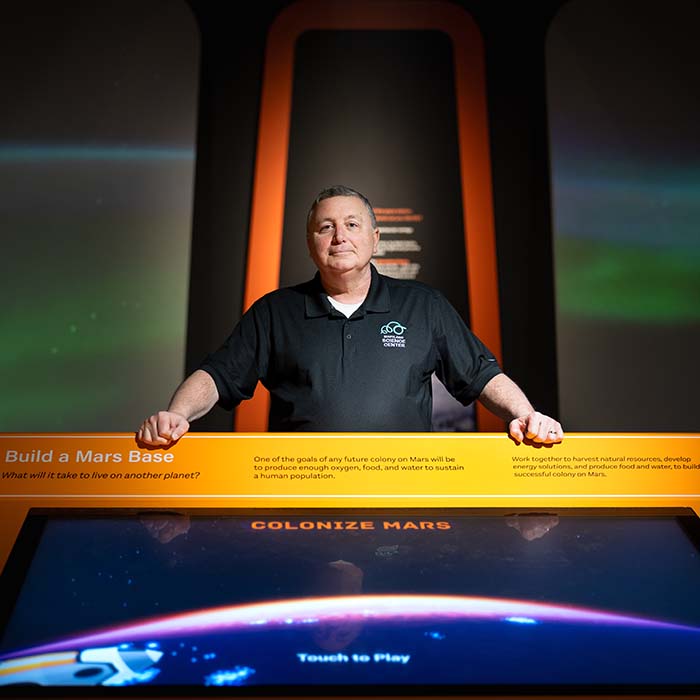
Mark Potter is strolling through the Maryland Science Center pointing out exhibits, beaming with pride. He’s worked for what some call the first jewel of the Inner Harbor for more than 15 years, the last nine as its president and CEO, playing a key role in its renaissance.
“Space is a hit,” he says of the center’s latest exhibit, which opened in December. In fact, it may be too much of a hit. For a facility that welcomes 400,000 guests a year—roughly 100,000 of whom are Maryland schoolchildren—wear and tear on exhibits designed for maximum interaction is a real issue.
“One of the biggest challenges operating a science center is keeping everything working because people love our exhibits. They love them to death,” he says. “Within two weeks of opening, the fabricators had to come back to fix numerous things that have been overly loved.”
But no one loves the science center quite like Potter, who came on board in 2011 as vice president of development. He’s quick to point out that he’s not a “science guy.” He may not be Bill Nye, but Potter is very much a Maryland Science Center guy.
Leadership success
“Mark has been an extremely strong and effective leader,” says Laurie Schwartz, who retired as president of Waterfront Partnership of Baltimore in July. The nonprofit is dedicated to enhancing and promoting the waterfront district.
“His strong development experience and local relationships have brought an infusion of private corporate and philanthropic dollars, without which the science center wouldn’t be able to provide new exhibits and experiences that bring fun, a sense of exploration and learning for so many of Maryland’s children.”
Our exhibits are merely a backdrop. It is our staff who bring science to life for our guests.
Mark Potter
Always humble, Potter is quick to deflect credit.
“My success in leading the science center is a result of our wonderful, dedicated and creative staff, a committed board of trustees and our loyal donors, without whom we would not have accomplished any of this,” he says.
Exhibits loved by all
As he walks the center’s 140,000 square feet of public space on a cold January morning just before the front doors are set to open and welcome an avalanche of those excited kids, he seems to be the one having all the fun.
“That’s Maryland’s state dinosaur,” he says in the shadow of a 30-foot fiberglass replica Astrodon johnstoni, whose tiny head peers out a wall of windows with a stunning view of the harbor and downtown Baltimore.
The dinosaur exhibit also underwent a recent renovation. “This space was painted for the first time in 20 years. That beautiful mural was painted by one of our staff members. All the technology has been changed out. Our monitors are touch screens now. This is one of our most popular exhibits. Everybody loves dinosaurs.”
True. But there’s one attraction in You—The Inside Story, that always seems to elicit an audible reaction from visitors. The exhibit, which covers the miracle of the human body, has the only fart simulator in the United States. Press a button and you’ll hear three varieties of passing gas. (Fortunately, no aroma accompanies the sounds.)
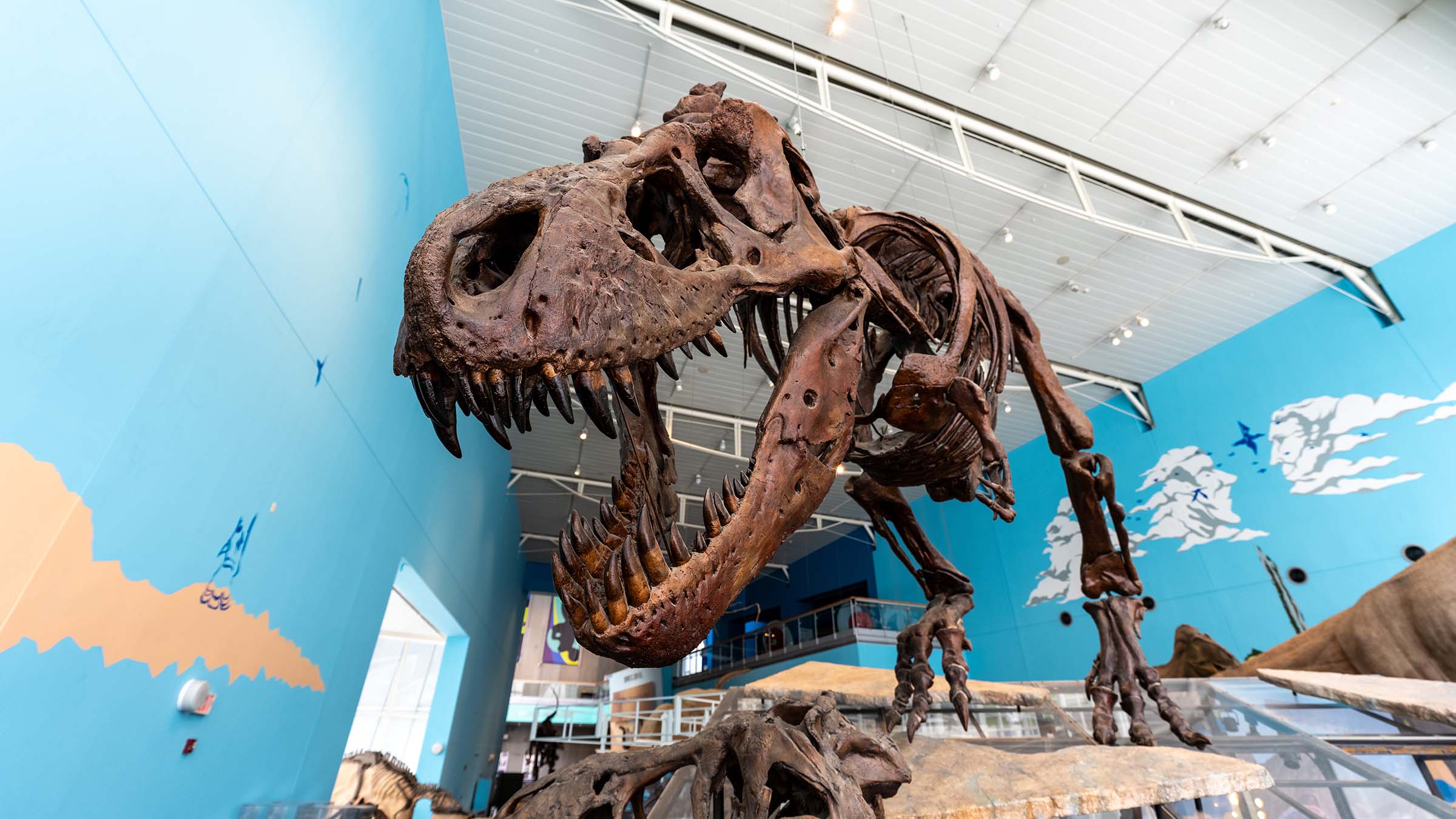
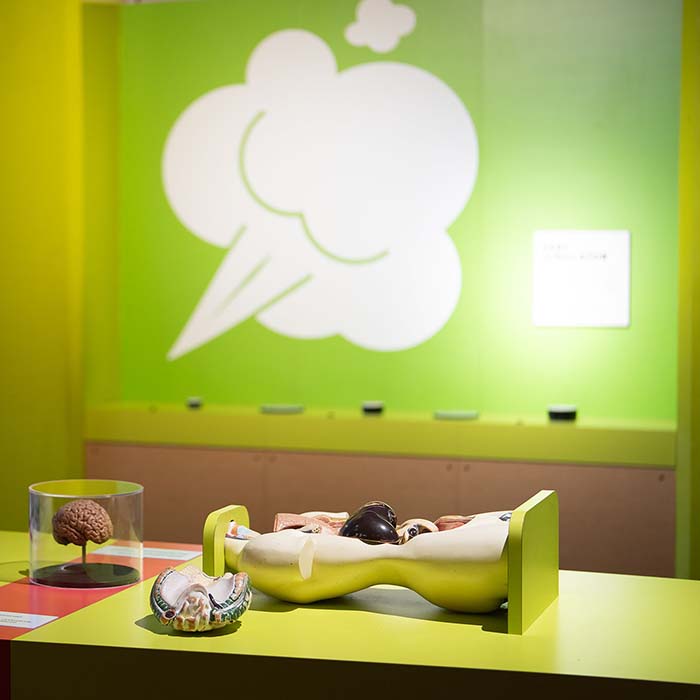
A T. rexi (left) and the fart simulator
“I guess I’m proud—I don’t know if that’s the right word,” Potter says, chuckling. “The kids love it, but the adults love it more.”
With its early childhood center designed for the littlest learners, adult nights featuring booze and planetarium shows set to the music of bands like the Grateful Dead and Talking Heads, an IMAX theater that is the largest indoor screen in the state, an observatory—and yes, faux flatulence—the Maryland Science Center, Potter wants all to know, truly does have something for everyone.
But the flashy technology, awe-inspiring installations and cool events are not what
continue to make the center one of Baltimore’s must-visit attractions, he says.
“Our exhibits are merely a backdrop. It is our staff who bring science to life for
our guests.”
History of the Science Center and how Potter got there
Potter, 64, was born and raised in Baltimore, and he remembers when the Inner Harbor wasn’t a tourist attraction but a working harbor. One of the first steps toward its reimagining came in 1976, when the Maryland Science Center opened in its current location, anchoring the south side of the waterfront. Harborplace opened in 1980, the National Aquarium a year later.
The Maryland Academy of Sciences, still the science center’s parent name, was founded in 1797.
But the organization’s DNA dates to well earlier than that. The Maryland Academy of Sciences, still the science center’s parent name, was founded in 1797. Throughout the decades, brainy science types would meet throughout the city to discuss the scientific advances of the day. In fact, George LaTour Smith, the first head of the science department at the Maryland State Normal School (now TU) was a member and curator for the academy in the 19th century.
Potter remembers going downtown to visit the new center, but he certainly never thought that he’d work there. When he enrolled at TU, he majored in history and minored in secondary education. The only science class he took as an undergraduate was geology. It wasn’t his favorite course, but he enjoyed his TU undergraduate experience, which included student teaching in Baltimore County, so much that he returned to earn his master’s and served as president of the alumni association for four years in the ‘90s.
He held down three jobs to work his way through college (including at SECU, where he once was then-TU president Hoke Smith’s loan counselor) before becoming a teacher at Archbishop Curley High School for 17 years. It was there that he stumbled—or was pushed—into the world of fundraising.
The school was celebrating its 25th anniversary and wanted someone to put together a book marking the milestone. Potter, who was the yearbook editor as a student there, was asked to take on the job. He pulled it off—even making a profit.
“The principal at that time came to me and said, ‘Would you like to be the development director?’ I said, ‘I really don’t want to do that. I’m a history teacher,’” Potter recalls. “He said, ‘Well, it comes with an office and a phone.’ That’s power if you’re a teacher. Unfortunately, the office ended up in the basement. But I started down that track. I think being a teacher provides you with the No. 1 skill you need to be a good development professional, which is the ability to communicate, the ability to reach people.”
The career shift led him to the Baltimore Basilica, where he helped lead a campaign to complete a restoration and a national celebration of its 200th anniversary. In 2011, he moved to the science center, and he hasn’t looked back.
“Mark is super passionate about what he does,” says Mark Zimmerly, chair of the science center’s board of trustees. “He grew up in that fundraising world where he understands the importance of relationships. He does a great job connecting with the community, with what’s going on downtown and with the waterfront. He’s just really good with people.”
The future of the Science Center
When he became president and CEO in 2017, Potter embarked on a systematic plan to upgrade just about every facet of the operation. First was instituting annual raises for the employees (which now number 45 full-time and far more part-time). No detail was too small to overlook.
“Even for board meetings, they served pastries and coffee,” he says. “We’re bringing together some of the biggest minds in Baltimore four times a year. Can’t we do a catered breakfast? We do that now. I mean, I’m Italian, so it’s always about food.”
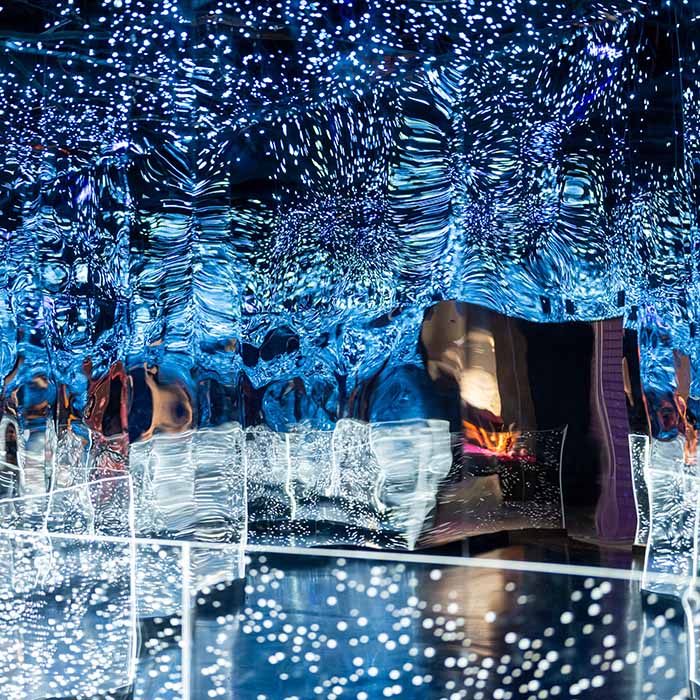
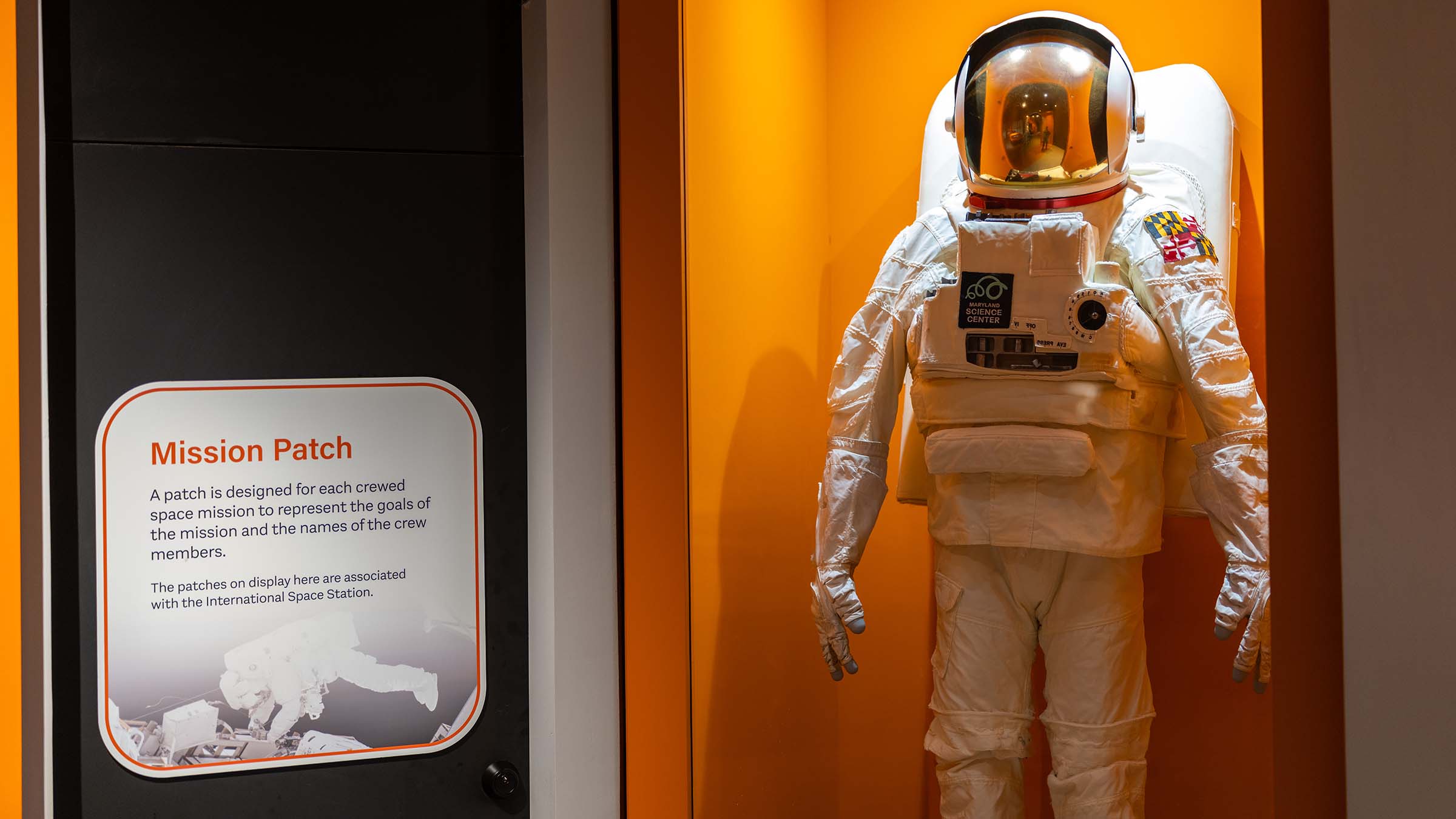
The Space exhibit at the Maryland Science Center
Potter navigated the center through the pandemic, presided over the opening of the human body, space, and several other exhibits, as well as the conversion of the IMAX theater from film to digital. He is now helping lead a capital campaign in honor of the 50th anniversary. The center is a state-aided, not state-owned, facility. Sixty percent of its revenue comes from admission fees. A mixture of grants from the state, corporate sponsorships and individual donations comprise the rest. That money covers free admission for Maryland school groups and goes to programs like Access Science, which allows anyone holding a Maryland SNAP or Maryland WIC card to purchase up to four tickets for $5 each.
Additionally, the center has outreach programs that visit 55 Head Start classrooms in Baltimore City and on-site events throughout Maryland.
Implementing some of those programs is among the responsibilities of Karen Via ’04, the center’s director of education.
“I think we do an excellent job of communicating big science topics in a way that is approachable,” she says. “Everyone here works to make sure that we’re clear on the fact that you are a scientist. You can’t be bad at it and be a human. So you don’t have to worry about someone telling you that you’re not very good at science. You can do it, and we can make it fun and engaging and interesting.
“Mark is a real champion of this place,” she says. “He feels like we are important, and you should absolutely think so too.”
I think being a teacher provides you with the No. 1 skill you need to be a good development professional, which is the ability to communicate, the ability to reach people.
Mark Potter
Among the major projects scheduled to coincide with the 50th anniversary is a rebuilt entryway that will feature more green space and fewer hard surfaces. Groundbreaking for the $2 million project will happen in June. The center is working with MCB Real Estate, the firm redeveloping the Inner Harbor, to ensure that the new entrance and an adjacent urban farm will seamlessly fit into the new surroundings.
A framed autographed campaign poster asking people to “Vote for Baltimore. Re-Elect Mayor Schaefer” hangs on a wall in Potter’s office. He’s always admired the late William Donald Schaefer, who’s largely credited with creating the public will to develop the original Inner Harbor. Never did the man to whom Schaefer signed, “To Mark, Best Wishes” think that he’d be leading the largest provider of informal science education in the state through a landmark anniversary and into the Inner Harbor’s latest iteration.
“I probably say it too many times, but experiential learning is what we are all about,” says the non-science guy. “A visit to the science center is not a static experience—you have to participate. This isn’t the Smithsonian. We make sure that you get involved with what we’re doing.”