Our Town
Capital One Arena
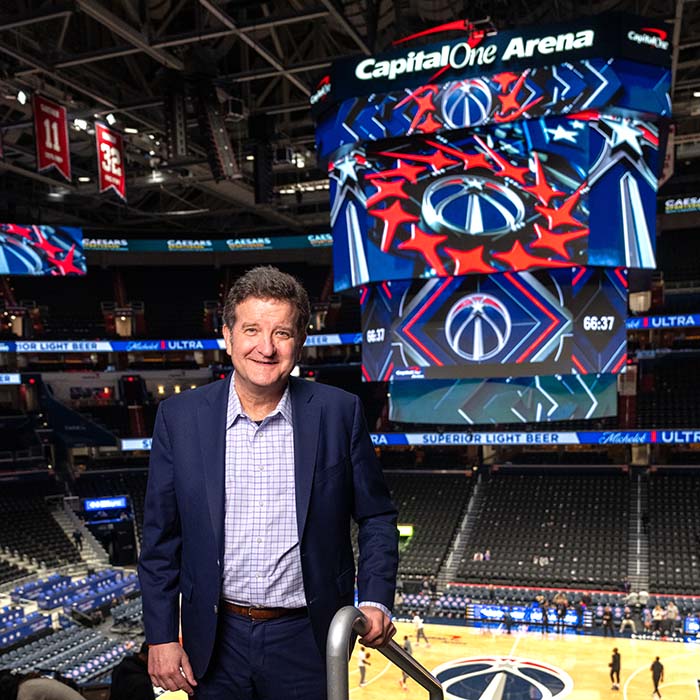
Dave Johnson ’86 has called thousands of Wizards basketball games at Capital One Arena.
An hour before the Washington Wizards tip off their late October game against the Philadelphia 76ers, Dave Johnson ’86 is hunched over his computer at the radio desk on the 200 level of Capital One Arena. As he has for nearly 30 years, he’s meticulously scouring statistics and rosters, preparing for the game. Despite being the radio announcer, he’s dapper in his crisp blue suit, his thick brown hair immaculate.
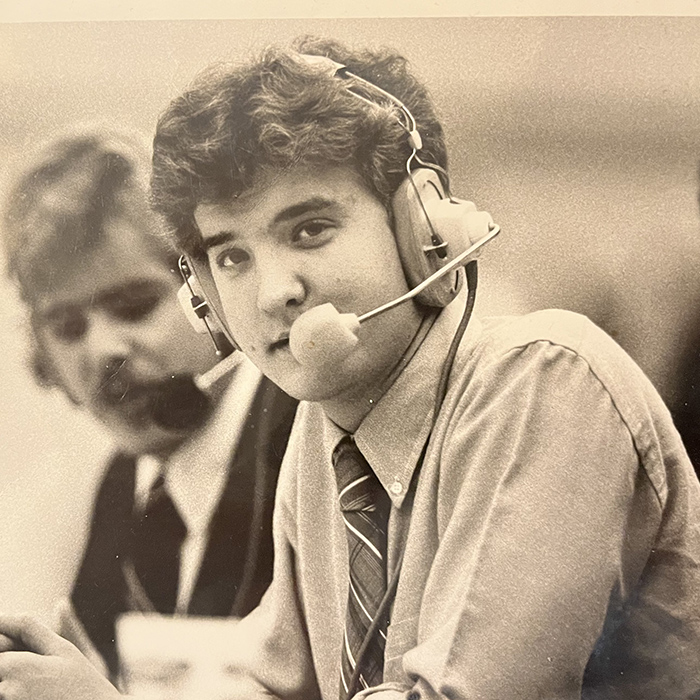
Johnson, 61, looks much like he did when he called TU basketball, lacrosse and football games as an undergraduate in the mid-1980s. That is, until he gets up from the desk and ascends the arena’s stairs to the concourse.
He’s slightly hunched over and uses a cane to stabilize himself. In 2019, he was diagnosed with multiple sclerosis (MS). It hasn’t affected his decorated career, for which he was inducted into the D.C. Sports Hall of Fame in 2024. But it’s a condition that, he knows all too well, will never get better.
Battling MS
“I’m not doing as well as I was last year, but I'm still walking, I'm still talking,” he says. “Your body is attacking itself. So that's kind of an unfair fight. But there's so many things that can be a death sentence, quite frankly. This is not.”
MS has been an unwelcome presence Johnson’s entire life. His mother, Mary Lue, was stricken with the disease. He’s active with the MS Society because he knows how important it is to raise money for research.
“When my mom had it, they just said, ‘Well, good luck,’” he says. “The first treatment to slow down the progression was in 1994. Now there are about 20 treatments.”
Mary Lue died when Johnson was 15, but before she passed, when she was confined to a wheelchair, he would stage pretend broadcasts of sporting events to entertain her. It was the start of a sportscasting career that has taken him to the loftiest heights.
Early career
Growing up near Annapolis, Maryland, Johnson was a fan of Washington’s NBA team, then called the Bullets. He chose TU for college because of its mass communication program and took full advantage of all the opportunities it offered when he arrived on campus. He worked at the student-run radio station and as a fill-in deejay at a commercial radio station. His big break after graduating came when he was hired to broadcast Naval Academy football, basketball and lacrosse games.
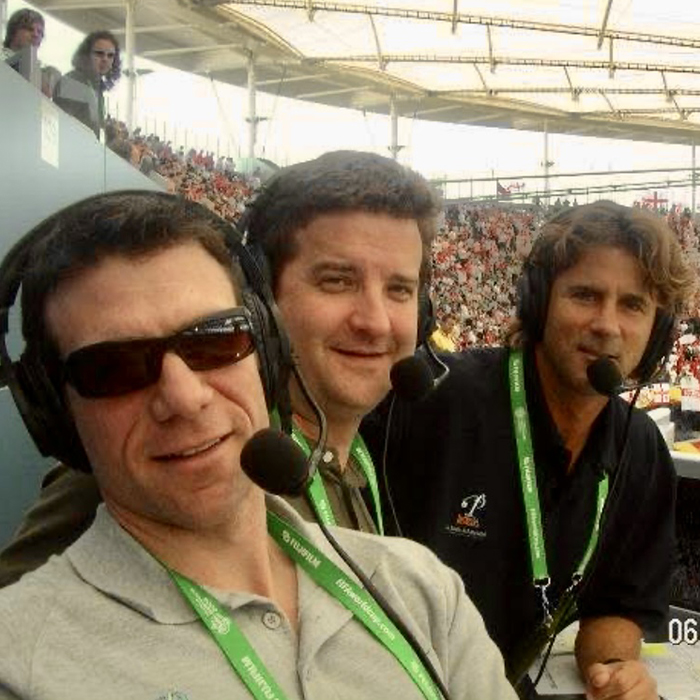
He went on to become sports director at WTOP radio in Washington for 30 years and was D.C. United’s television play-by-play announcer for 27 (he still does the team’s radio broadcasts). The press box at the team’s home, Audi Field, is named after him.
The soccer job led to what Johnson says is the pinnacle of his career: calling the 2006 World Cup Final between Italy and France at Olympic Stadium in Berlin, Germany.
“Everything from the event to the history of the venue, the Olympic Stadium where Jesse Owens ran, was special,” he says, still sounding awestruck. “The entire world was watching.”
Working for the Wizards
In 1997 Johnson became the radio voice of his beloved hometown NBA team, the Wizards. His on-air partner for 20 of those years has been Glenn Consor, who is continually amazed by the preparation and skill with which Johnson approaches the job.
Unlike television, it really allows you to be creative. We think about football and baseball, and there are natural pauses all the time. But in basketball you really need to describe the action.
Dave Johnson ’86
“His passion for broadcasting Wizards games supersedes any disability that he might have at getting around,” Consor says. “I was working with him before he had MS. Nothing has changed. He gets there at the same time, he’s just as dedicated. He’s the ultimate professional.”
Broadcasting basketball on the radio takes a keen eye, sharp mind and quick tongue, talents anyone who’s listened to one of Johnson’s broadcasts knows he possesses.
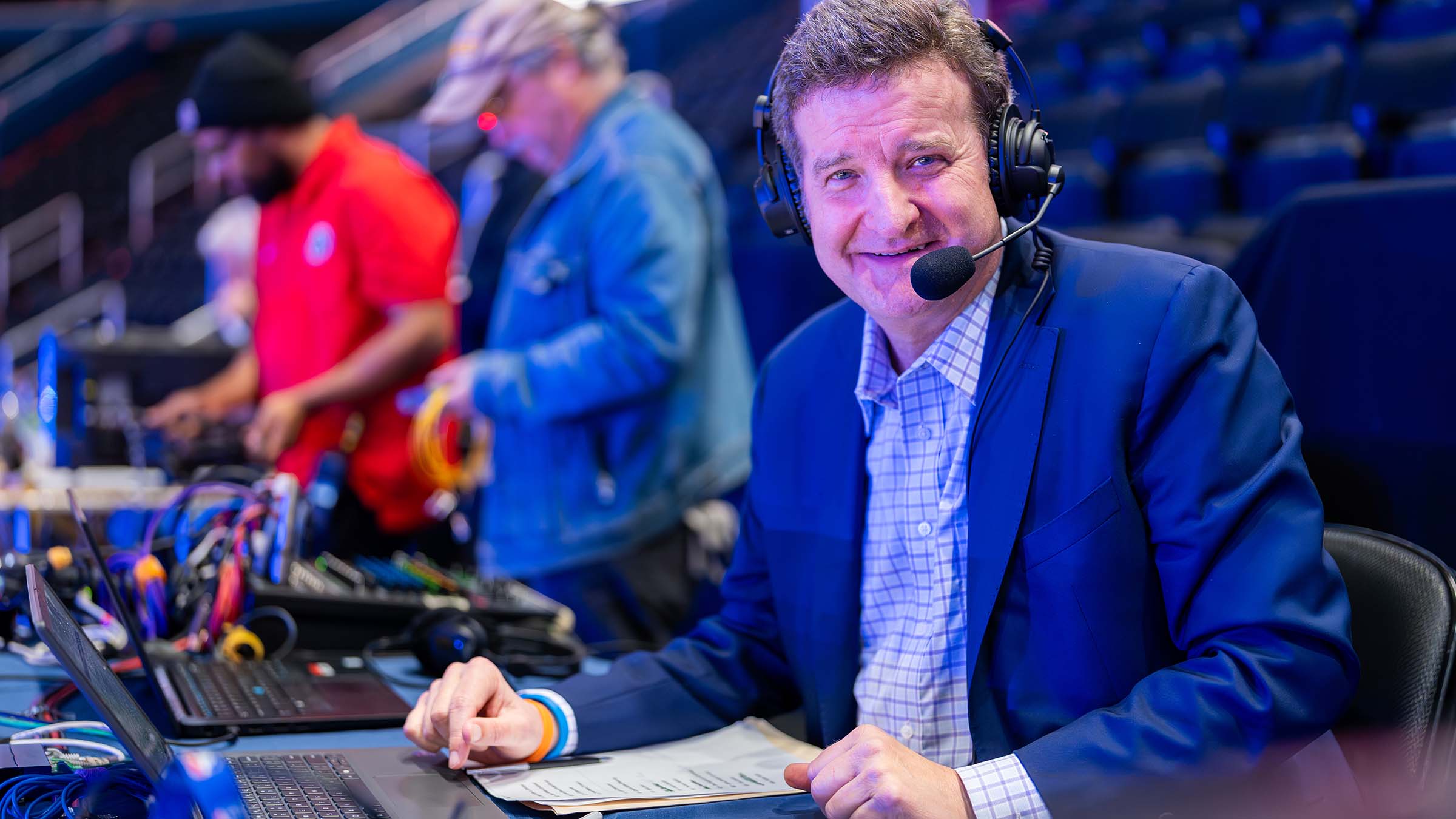
“It's fun because you really have to paint a picture,” he says. “So unlike television, it really allows you to be creative. We think about football and baseball, and there are natural pauses all the time. But in basketball you really need to describe the action. And remember, people could be tuning in at any point, so you’ve always got to get to the score.”
In a statement announcing his induction to the D.C. Sports Hall of Fame, the organization called him “arguably the area’s most popular and versatile sports voice.” It’s praise that humbles him, for a job of which he never tires.
“I believe to this day, those two and a half hours, you’re in a cocoon of joy,” he says. “You're going through whatever, but none of that matters. You’re yelling and screaming for the team. You're going to go back to real life soon enough.”