Research
Developing scholars producing cutting-edge research
TU is breaking new ground, complementing current knowledge and leading to solutions for the public good.
Humanizing AI education
The breadth of information technology and cybersecurity research taking place at TU prompted the creation of the Towson Artificial Intelligence Institute (TAI).
As AI continues to evolve across professions and industries, TAI faculty and staff are providing opportunities for students and faculty to apply AI in science, health care, business, education, the arts and more to foster impactful and ethical innovation that is responsive to societal needs.
The incorporation of AI research and education across disciplines at TU has already made significant impacts on the future of AI education and integration in higher education.
The incorporation of AI research and education across disciplines at TU has already made significant impacts on the future of AI education and integration in higher education. That includes being tasked by the National Science Foundation and the National Security Agency to develop key national guidelines to define degree programs in “CyberAI.”
Spearheading mentorship
Designed to increase capacity for undergraduate biology research at TU, the Medium Duration High Impact Research Experiences (MD HIRES) is enabling TU faculty to be more effective and inclusive mentors while providing funded research opportunities to students.
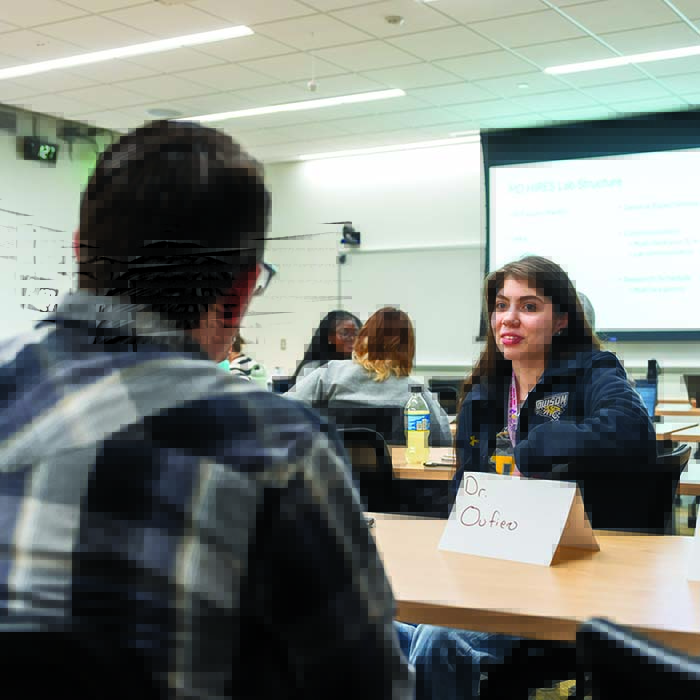
MD HIRES arose as an opportunity for students who participated in TU’s Course-Based Undergraduate Research Experiences (CUREs) to better connect research skills to career readiness and to explore research dissemination, communication and conflict management.
Through the collaboration of professors Laura Gough and Matthew Hemm, five faculty mentors are supporting student-run labs across biology disciplines.
“We wanted to find a way to help faculty manage more students than they would normally take on [in their labs] and provide students with more opportunities to do paid research,” Gough says.
Doctoral impact
TU doctoral programs develop interdisciplinary scholars who can mentor the next generations of students.
While less traveled than the university’s undergraduate programs, doctoral program enrollment at TU has doubled since 2022 across all four programs, and with the interdisciplinary nature of the programs, research opportunities and the dedication of the faculty and program directors, it’s evident why. These powerhouse programs are preparing the next generation of tenure-track faculty.
“Our Ph.D. programs are about more than producing research; they are about developing scholars who can ask and answer consequential questions, work across disciplines and mentor the next generations of students,” says David Ownby, interim dean of graduate studies.
These powerhouse programs are preparing the next generation of tenure-track faculty in information technology, building expertise on autism studies among faculty, enabling cross-cultural and generational collaboration in instructional technology and contributing to the betterment of health and well-being through consideration of occupational participation.