Podcast
Three Degrees: What International Students Wish You Knew about Grad School in the US
International students share about their experience at TU.
Studying abroad can be exciting, transformative and sometimes overwhelming. For international students pursuing graduate education in the United States, the experience often includes cultural surprises, new academic expectations and the challenge of building community far from home. In this episode, students from Nigeria, Poland and Ghana share how they adapted to life in the U.S. and what they wish others understood about studying abroad.
Abisola’s Story: Expectations of the U.S. Sometimes Differ from Reality
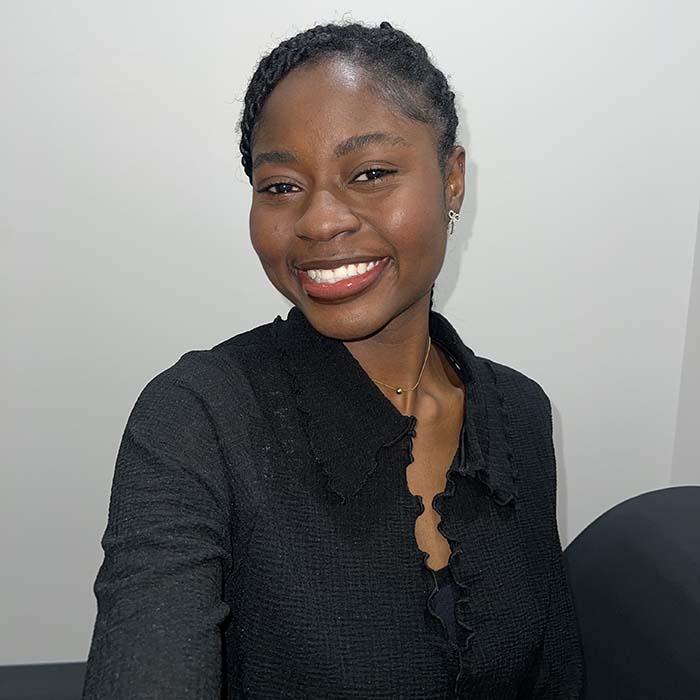
Many international students arrive with ideas about the United States shaped by movies, television and media. But everyday life in the U.S. can feel very different once they arrive. This was true for Abisola, who moved from Nigeria to pursue a master’s in health science.
“I expected it to be more, should I call it, bougie?” she said when asked about her first impressions. “More classy than what I see now.”
Though life in America wasn’t quite like the movies, she found aspects of life in Maryland surprising—especially the cost of living and the need to carefully manage expenses.
Abisola initially felt the contrast between the strong sense of community she experienced back home and the more individualistic lifestyle she encountered in the U.S.
“Back home, if you want to pay your rent, you actually pay once a year, but right here it's once a month,” she said. “So it was really shocking to me that I have to pay rent every month.”
Adjusting to social norms also took time, including punctuality and the fast-paced nature of daily life.
“So it's like everyone is busy,” she said. “It makes me feel like I'm the less busy one… like I have to find something to do because everyone has something they're doing.”
Abisola initially felt the contrast between the strong sense of community she experienced back home and the more individualistic lifestyle she encountered in the U.S. Wanting to create meaning from that experience, she started a podcast about personal growth and began volunteering in the community. Through those efforts, she found ways to build her own sense of purpose and connection while continuing her academic journey.
Adrian’s Story: Finding Community in a New Country

For Adrian, who moved from Poland to study Supply Chain Management in the United States, some of the biggest surprises were practical ones—especially transportation.
“Definitely the car dependency,” he said. “...I was looking for like public transportation... by bus, by tram, by train, just anything...I never thought about buying a car, but I quickly realized there's no options. There's no choices.”
Beyond daily logistics, Adrian also had to adjust to differences in the classroom. In Poland, he said, education tends to be more formal and structured.
“In Poland, the education system is very strict... We didn't really ask questions of our professors,” he explained. “Coming to United States, I was surprised how especially like in college, kids in the classroom they, they also feel more comfortable with the professor. They ask questions. They have more relations with the professor. It's almost like a conversation in the classroom.”
Language also created early challenges. Even though Adrian spoke English well, adjusting to new accents and voices made lectures difficult to follow at first.
“...I couldn’t understand like half of the lecture,” he said. “So, I would just sit there and understand some words. I would have to go home and like, read the book again."
...I was surprised how especially like in college, kids in the classroom they, they also feel more comfortable with the professor. They ask questions.
Adrian
Over time, Adrian built confidence by getting involved on campus. He joined the Supply Chain Club and eventually stepped into a leadership role.
“So I raised my hand and I was like, ‘hey, I want to be vice president.’ And they let me do it,” he said. “And looking back, I never thought this would happen, but it did happen. So I just had to try. I had to push myself to do it to be there, to be exposed.”
What started as uncertainty, navigating a new country, classroom and language, eventually became an opportunity for growth. By putting himself out there, Adrian found confidence, community and a place for himself on campus.
Herty’s Story: Showing Up as Yourself in the Classroom

This is the second time Herty has left Ghana to study in the US. This time, it’s to earn her master’s degree in Communication and Advocacy at TU. Though pursing her second degree in the U.S., Herty shared that she still felt nervous during her first days of class.
“It was nerve-wracking because I didn’t know anybody,” she said. “I was very careful of my choice of words because I didn’t know what to say.”
Instead of withdrawing, she focused on building connections and sharing her own cultural perspective.
"Even though coming from a different background I'm coming with a different experience and culture background, which is also rich,” she said. “So I thought of it as how can I balance it out to help myself. So if there's a conversation that's going on in the classroom that I feel I can contribute to that conversation based on my experience and my perspective, and make other people also understand...and get to know more about me.”
It was nerve-wracking because I didn’t know anybody. I was very careful of my choice of words because I didn’t know what to say.
Herty
That mindset helped her find community both within international student groups and among American classmates. Today, she encourages other international students to approach the experience with patience and openness.
“I would say have an open mind,” she said. “Allow yourself to go through the process, like especially when you get in here, give yourself some grace because you are in a new space that is completely different from what you've been used to your whole life.”
By embracing her differences and leaning into new experiences, Herty was able to build meaningful connections and a sense of belonging. Her story highlights how openness and a strong sense of self can help navigate uncertainty.
This summary narrative of a TU original podcast titled "Three Degrees" was created with assistance from artificial intelligence.
About the series

The Three Degrees podcast series dives deeper into the lives and experiences of Towson University graduate students, exploring what sets them apart — and more importantly, what brings them together.
Three Degrees is available here and on: