It is to learn, so as to teach.
Feature
TU honors a history of academic excellence and emphasizes its momentum as a premier university in research, innovation and student success.
The very first catalog of what was then called the Maryland State Normal School is just 13 pages long. It details the five instructors (principal, assistant principal and teachers of drawing, music and calisthenics), tells the exceedingly short history of the school, lists enrolled students and explains admissions, curriculum and fees.
The booklet also clarifies the school’s mission: “It is to learn, so as to teach.”
In the ensuing 160 years, the mission has expanded:
As the normal school evolved into a state teachers college to a state college to a university, TU’s reputation has attracted national accolades and its impact is felt in the state, the Mid-Atlantic region and around the world.
Today’s graduates, though, have essentially the same mission as the first: Learn, grow and become effective leaders for the public good.
On Jan. 15, 1866, 10 students registered at the Maryland State Normal School (MSNS). The school focused on training new teachers to the same standards or norms, hence the unusual name.
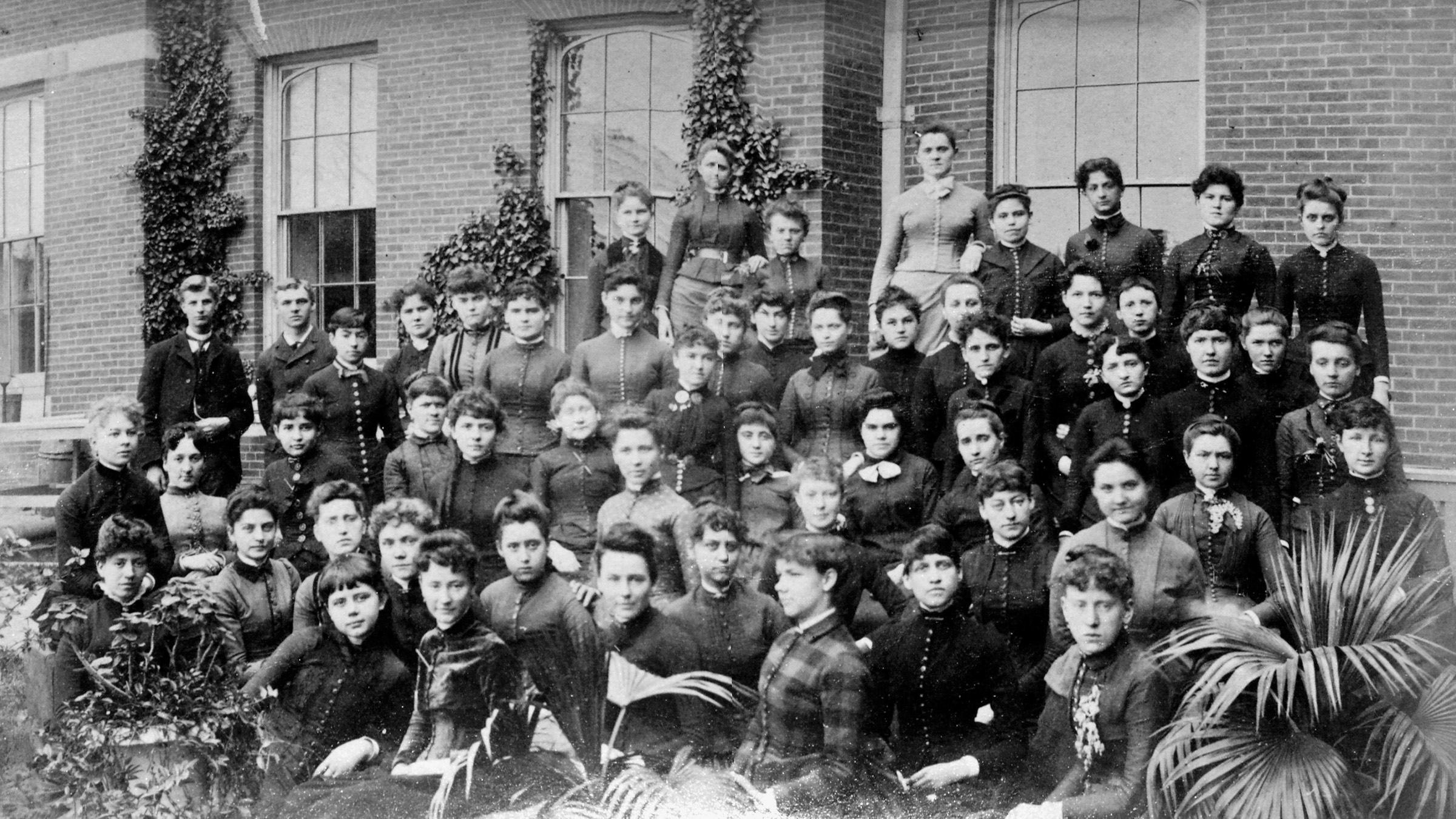
The Class of 1886: The male student on the far left standing in front of the ivy is J. Charles Linthicum, future U.S. senator for Maryland and advocate for the "Star-Spangled Banner" to serve as our national anthem. The photo was taken at the Carrollton Building.
A state legislative act in 1864 had provided funding for public schools as well as the education of future teachers and sought to level the playing field by creating MSNS. Education in the state had been administered inequitably, with wealthier counties and Baltimore City providing opportunities that were not available to all children in Maryland.
While the students enrolled tended to be young women, the school was co-educational from the very start. It’s first home was a rented hall—less than ideal for the large lecture-style classes in fashion at the time. Tuition for many of the students was free.
“Those who pledge themselves to teach in the Public Schools of the State have nothing to pay for Tuition or Books,” declared the first catalog. This Pledge to Teach program was in place for more than 100 years, providing many students access to an education they would otherwise be unable to afford.
In turn, those students repaid this boon by providing education to generations of children and becoming leaders in their communities. From its very start, the school that would become Towson University was committed to enriching the lives of the people of Maryland.
Maryland State Normal School eventually found a home in West Baltimore at Carrollton and Lafayette avenues. But as enrollment grew and education practices changed, the building quickly became outmoded.
The school built additional structures on the small plot of land on which the school stood, but there were no dormitories, which meant that students who lived in areas too far away for daily commutes had to rent rooms in nearby boarding houses.
[The] Pledge to Teach program was in place for more than 100 years, providing many students access to an education they would otherwise be unable to afford.
School leaders decided to relocate the school to a more suburban location, where they could build dormitories to house students and additional classroom buildings as needed. The state agreed, and in 1915, MSNS moved from Baltimore City to 88 acres of former farmland in Towson.
When the school opened in Towson in September 1915, all classes were held the Administration Building, now known as Stephens Hall. The building also had an auditorium, all the administrative offices, a library, the campus elementary school and a small cafeteria that would eventually be used by commuter and elementary school students.
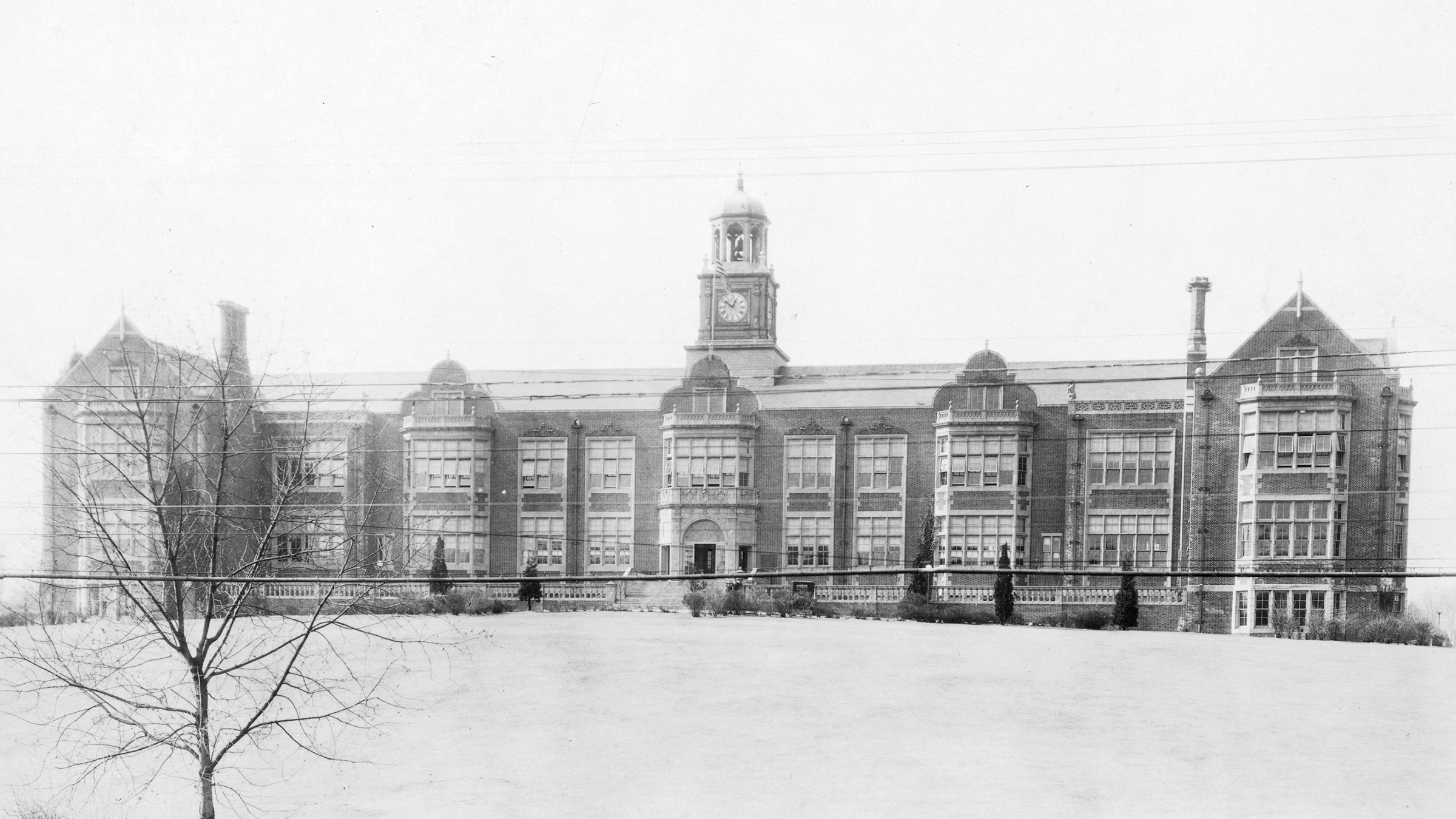
An early view of Stephens Hall, then called Administration Building, which housed all classes, an auditorium, all administrative offices, a library, the campus elementary school and a small cafeteria.
Another cafeteria was part of the addition to the first dormitory that opened that year, Newell Hall. The only other building constructed for the new campus was the power plant. Besides fueling the other buildings on campus, it also had space for a basketball court, and at some points, served as a large dormitory space for the few men who needed housing.
The elementary school on campus was used not just as a space to model best teaching practices for student teachers but to serve area schoolchildren with an exemplary educational experience. This school, eventually known as the Lida Lee Tall School, served the state for more than 100 years.
The draft instituted during World War I revealed that America’s young men were not at peak fitness, so the government began issuing grants to schools to support health and physical education departments. MSNS received money and began offering more classes to teach health and physical education.
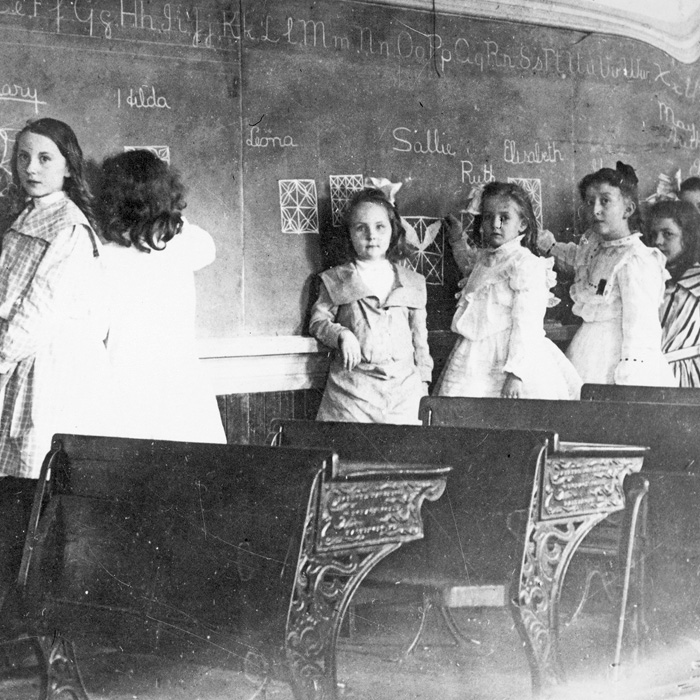
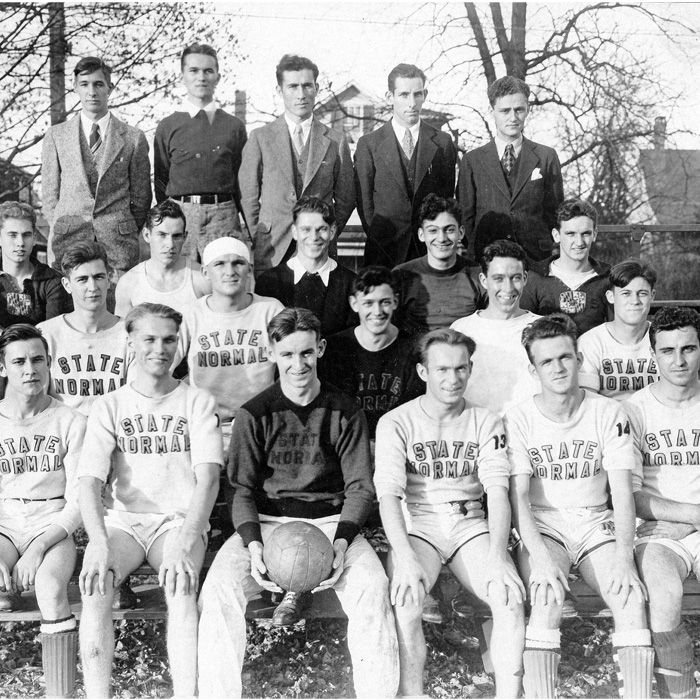
(left) Students at the Lida Lee Tall School on MSNS’s campus in the early 1900s; the 1932 men’s soccer team photo: Head coach Donald “Doc” Minnegan (third from left in the top row) was hired in 1927 and led the physical education instruction efforts until his retirement in 1969.
The move to a new campus and the renewed focus on physical education were bolstered by the hiring of Mary Roach and Donald “Doc” Minnegan. Both worked at the school for more than 40 years, finding new athletic opportunities for students, even when the physical education department was comprised only Roach, Minnegan and one other instructor. Activities were split by gender, and while most of the students enrolled were women, varsity sports were available only to men until the passage of Title IX in 1972.
Under their leadership, the school began to play competitively against other colleges, first in soccer and basketball. Sports events became a unifying element for the campus. Students gathered to watch soccer and then football games for Homecoming weekend. Each team had a different mascot, but in 1963 the tiger was created to rally students.
Eventually, the tiger would be named after Doc Minnegan.
In 1935, the school awarded bachelor’s degrees for the first time and changed its name to the State Teachers College at Towson (STC).
The catalog by this time was very dry and full of facts and information:
While it was designed to be as useful as possible for future teachers, it does give details about the student activities one could expect to enjoy when attending.
While teacher education remained the primary focus of STC, the school’s response to World War II created a new opportunity. During the war, the school kept in close contact with those serving in the military.
After the war, hoping to attract veterans and their GI Bill benefits, the school created the Junior College program. This two-year general education program allowed students to begin their higher education at Towson and transfer those credits to another college to finish their degree.
This program not only created an enrollment uptick, it also laid the foundation for programs that eventually led to the transformation of the school from a teaching college to one devoted to a comprehensive education, further demonstrating the school’s desire to find new ways to serve the community’s best interests.
The 1954 Supreme Court ruling on Brown v. Board of Education opened Towson to Black students. The first Black students enrolled in fall 1955. Four Black women graduated in 1956 in what was known as the “Fifth Year” program. They held bachelor’s degrees from other institutions and attended STC to add to their academic experience.


Marvis Barnes ’59 (left) and Myra Harris ’59
In 1959, Marvis Barnes and Myra Ann Harris were the STC’s first four-year Black graduates. The catalog from that year states: “It is the objective of the State Teachers College at Towson to offer a broad educational program which will fit its graduates to become intelligent, active citizens and effective members of the teaching profession.”
Two dormitories, Barnes and Harris halls, were named in their honor in 2022.
By the early 1960s, it was apparent that higher education was in demand, and Maryland sought new pathways to meet that demand, particularly as the Baby Boom increased the number of prospective students. The state redesigned teacher education colleges to liberal arts colleges, so the State Teachers College at Towson became Towson State College in 1963.
It would take another year for the catalog to reflect the objective of this new mission: “The Towson program rests fundamentally on the idea that a liberal education is indispensable for the preservation of a free society.” This philosophy remained in place for the next 20 years.
Towson’s ability to navigate this change was aided by the work it had done to establish the Junior College, which had created unexpected outcomes. With the increase in male students on campus, the school began exploring the feasibility of fielding a football team in the mid-1960s.
Real-world learning continued to be an important part of Towson’s educational experience.
For almost two decades, the school grew in program offerings, enrollment and physical size, creating avenues to ensure student success. Real-world learning continued to be an important part of Towson’s educational experience. Nursing students were placed in nearby hospitals to gain field experience, just as teaching students had been for the last 100-plus years. International student and faculty exchange programs opened the world to community members studying abroad.
To support all the new programs and endeavors underway, the campus began expanding in the 1960s. Stephens Hall had been the primary building on campus holding all classrooms, administrative offices and even the library until 1957.
In rapid succession, the school built the library (1957), Smith Hall (1965) and Linthicum Hall (1968). As enrollment grew, the academic core continued to push west, with the University Union and more dormitories built on the peripheries of campus. Between 1960 and 1980, 17 new structures appeared on campus, almost one new building per year for two decades.
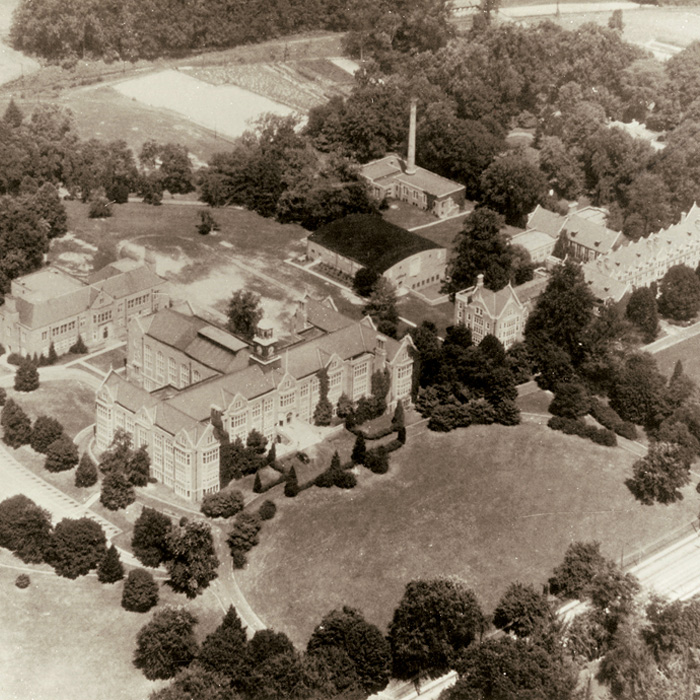
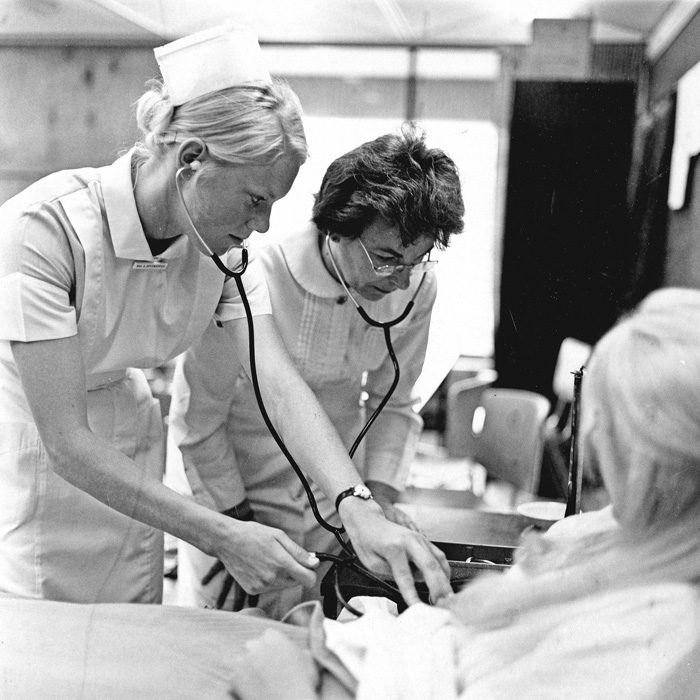
(left) A 1940s aerial view: Between 1915 and 1946, the campus buildings total had doubled. Stephens and Newell halls and the Power Plant were joined by Richmond and Van Bokkelen halls and the first gymnasium; nursing in 1974: instructor Jane Wiley (right) and Sally Diffenderffer ’76 taking vital signs. This photograph was taken in May/June 1974. The nursing program had been established two years prior.
These changes were reflected in administrative changes. In 1976, the name changed once again to reflect the robust degrees it offered, becoming Towson State University.
Amid all this change, the relationship between students and administrators was also evolving. Since its inception the school had served as a stand-in for students’ parents, but the change in mission from teachers college to one focused on comprehensive education, as well as the social upheaval of the 1960s and 1970s, altered that dynamic.
Community members began protesting on campus whether through demonstrations, sit-ins, student-led class sessions, new student organizations and writing in the student newspaper and other informational newsletters. School leadership changed, and students were granted more freedom including the relaxation of dress codes and dormitory rules.
The first co-ed dormitory, the Residence Tower, opened in 1972. It was also the first dormitory with air conditioning. All of this happened against a backdrop of tension in the state over the role of the school as well as the economic hardships of the 1970s. Creating a robust academic institution as well as a welcoming social environment was a challenge for the school’s administration.
After years of change and growth, during the decades right before the turn of the new millennium, the school focused on enhancing the academic program. Enrollment remained steady with about 15,000 students. New educational opportunities for students were created with the establishment of the School of Business and Economics in 1982. That year, Towson State University established the current college system to organize academic departments.
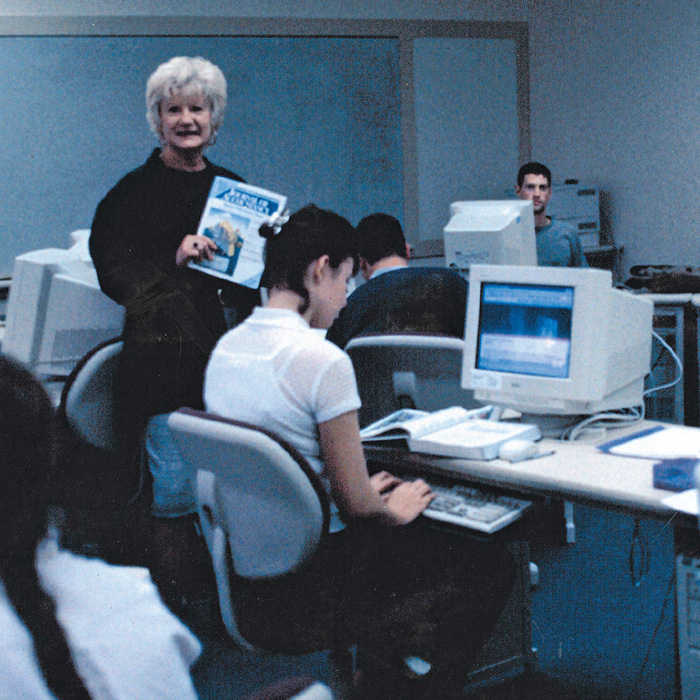
Promotional campaigns created at the time highlighted the school’s impact on the state workforce. And while no new academic buildings were constructed, student services buildings and support became the focus. Starting in 1983, the Glen Complex opened dormitory space to another 500 resident students as well as providing another dining facility.
In 1984, the school tweaked the philosophy that had been in place since 1964: “The curricula, services, and activities of the university are shaped by two primary goals: That all students encounter the values and methods that establish a liberal education, promote critical thought, and develop mental habits required for thoughtful citizenship; and that all students, in completing undergraduate or graduate majors, have the opportunity to gain the knowledge and skills essential to their career choices.”
Again, the administration faced challenges meeting students’ expectations, providing a space for academic rigor and working within the bounds laid out by the state. Changing the school’s name in 1997 to Towson University was in many ways emblematic of all these concerns. By this time, the school’s philosophy had again changed: “The University helps all students develop a range of intellectual skills that will continue to enrich and shape their lives long after their formal education has ended.”
The opening of Millennium Hall in 2000 kicked off not just a renewed interest in growing the physical plant but a push into construction on the west side of campus.
Starting with heavy campaigning of the state legislature for funding, TU spent the next 10 years outlining a new vision for campus and upgrading buildings to better support students' continued academic growth.
The completion of the College of Liberal Arts building in 2011 was the school’s first new academic building in nearly 35 years. That year also saw the construction of two dormitories as well as the West Village Commons and garage.
Between 2000 and 2024, 29 structures were either created or enhanced across campus and beyond...
Between 2000 and 2024, 29 structures were either created or enhanced across campus and beyond, including the construction of TU in Northeastern Maryland in 2014 and the 2020 opening of the StarTUp at the Armory, a business engagement center and free co-working space in uptown Towson. These spaces showcase TU’s impact beyond its borders.
The construction boom is the most visible sign of TU’s investment in its community. Other ways that TU continues to build on its legacy as a strong community partner include BTU—Partnerships for Greater Baltimore, the Institute for Well-Being and the Osher Lifelong Learning Institute. In 2021, the Dr. Nancy Grasmick Leadership Institute opened, and the Ben and Myrna Cardin Center for Civic Engagement and Civil Discourse debuted four years later.
In the course catalog that now resides online, the first sentence of the mission statement reads: “Towson University fosters intellectual inquiry and critical thinking, preparing graduates who will serve as effective leaders for the public good.”
For 160 years, Towson University has served as a community leader, first in education and now growing up from its original mission to continue to meet Maryland’s needs.
1866
It is to learn, so as to teach.
1959
It is the objective of the State Teachers College at Towson to offer a broad educational program which will fit its graduates to become intelligent, active citizens and effective members of the teaching profession.
1964
It is the objective of the State Teachers College at Towson to offer a broad educational program which will fit its graduates to become intelligent, active citizens and effective members of the teaching profession.
1984
The curricula, services, and activities of the university are shaped by two primary goals: That all students encounter the values and methods that establish a liberal education, promote critical thought, and develop mental habits required for thoughtful citizenship; and that all students, in completing undergraduate or graduate majors, have the opportunity to gain the knowledge and skills essential to their career choices.
1997
The University helps all students develop a range of intellectual skills that will continue to enrich and shape their lives long after their formal education has ended.
2026
Towson University fosters intellectual inquiry and critical thinking, preparing graduates who will serve as effective leaders for the public good.