Stelter offers opinions and advice during visit to campus
The CNN correspondent and TU alum took a break from non-stop political coverage to meet with students and participate in a panel discussion.
By Ray Feldmann on October 24, 2016
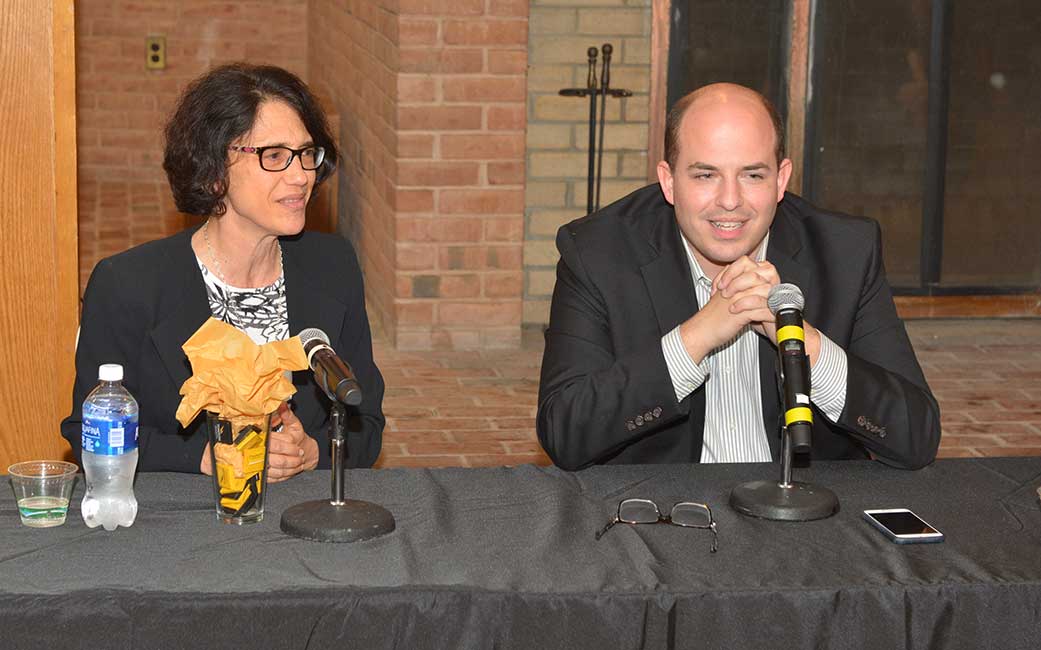
Brian Stelter '07 is clearly comfortable in his own skin. It’s apparent when he’s on the set at CNN, where he serves as a senior political correspondent and host of the popular “Reliable Sources” news program.
Stelter’s self-confidence and affable demeanor were also on full display on Towson University's campus last Thursday, when the alumnus returned for three back-to-back events, beginning with guest lecturing in professor Stacy Spaulding’s Multimedia Reporting Capstone class in Van Bokkelen Hall and culminating with his participation in a lively panel discussion entitled, “Journalistic Objectivity in the Age of Trump.”
“I’d would like to get back to Towson more often than I do,” Stelter admitted, “but with my schedule, I’m only able to get back here about once a year. I really want to come back for Homecoming one year. Maybe next year.”
Stelter was joined on Thursday’s panel by Washington Post Political Blogger Jennifer Rubin, Maryland Public Television Political Reporter Charles Robinson, and Free Press Senior External Affairs Director Joe Torres.
During the 90-minute discussion in front of nearly 200 students, faculty, staff and guests in the Union’s Potomac Lounge, the panelists offered their observations on a variety of topics, including the Trump candidacy, the media’s coverage of the GOP nominee and the state of journalism.
“There is a part of America that’s really pissed off,” Robinson said, referring to Trump’s contingent of diehard supporters.
“And journalists were too slow to realize that, including myself,” Stelter admitted. “We have to realize that 40 percent of the country will vote for Trump, maybe more, and we can’t just dismiss 40 percent of the country.”
Rubin agreed with Robinson’s assessment.
“Donald Trump is speaking to them on an emotional level,” she observed, “an irrational level, almost an empathetic level. He’s speaking their language.”
Torres referred to the Trump phenomenon as “dog whistling,” as if his supporters are able to hear his messages in a way that other cannot.
“But there is nothing funny about what Trump is saying,” Torres cautioned. “We see examples of bullying in schools where kids are using the same kinds of words and behavior that Trump uses.”
Rubin and Robinson both lamented the lack of diversity in journalism today.
“Journalism needs more people of color, more Jewish journalists, more Muslim journalists, people with a diversity of backgrounds and experiences,” Rubin said.
Rubin and Stelter also discussed the differences between solid reporting and pure entertainment, a line that is often blurred in today’s 24/7 news cycle.
“We are not in the entertainment business,” Rubin emphasized. “We’re still the ‘you have to eat your peas’ people.”
Stelter, who had flown to Baltimore Thursday morning after covering the third Trump-Clinton debate Wednesday night in Las Vegas, Nevada, pushed back against the notion of 24/7 news coverage being solely entertainment and against the concept of media bias.
“There’s good journalism and there’s good television,” Stelter noted, “and it probably works best when what we do is somewhere in the middle. I’m proud that I, and CNN in general, have stood up against Trump’s accusations of a rigged election.
“Journalists are compelled by the story,” Stelter continued, deflecting criticism that CNN in particular has given Trump too much air time without fact-checking and providing balance. “And Donald Trump was, and is, the story of our time.
“If I could wave a magic wand and have a different type of journalism,” he added, “it would be adversarial journalism.”
Prior to the Potomac Lounge panel discussion, Stelter carved time from his whirlwind schedule to visit with the current staff of The Towerlight newspaper, where Stelter served as editor in his senior year. Earlier in the afternoon, he sat comfortably on a desk in Spaulding’s class in Van Bokkelen and talked casually with students about journalism, politics, and his career. He offered the young men and women some advice about how to break into the highly competitive world of journalism and reporting.
Among those students in Spaulding’s class was Sam Shelton, who is currently The Towerlight’s senior editor.
“It was very cool to see him back in the Towerlight office,” Shelton said. “I was pleasantly surprised that he fit in so well. He is a very relatable person. We were able to sit around, joke and talk about politics and stuff. It was almost like he was part of the staff again.
“In professor Spaulding’s class he talked to us about finding a niche and doing something different than what your colleagues and classmates are doing,” she added. “I walked out of that class thinking about how I might have Brian Stelter’s job some day.”