Professor travels to Pakistan, shares value of project-based learning
TU part of grant bringing STEM education to remote middle-school teachers
By Rebecca Kirkman on January 18, 2019
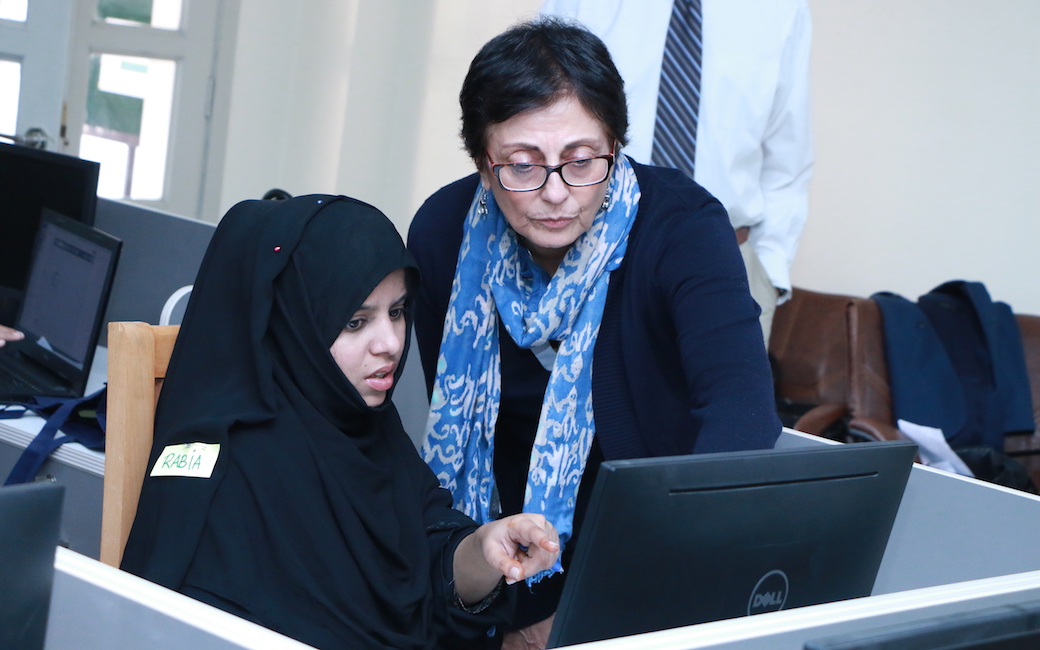
In a classroom at the University of Education, Lahore, Mahnaz Moallem leans over the shoulder of a Pakistani teacher to reference a computer running Squeak Etoys, an open-source software designed to help children learn through computer programming. This spring, the teacher will take the skills she’s gained back to her middle-school classroom in a remote area of the province of Punjab and teach her students about water resource management through problem-based learning.
Moallem, a Towson University professor in the College of Education and chair of the Department of Educational Technology and Literacy, arrived in Pakistan last month by way of a Department of State grant project created in partnership with the University of North Carolina Wilmington and the University of Education, Lahore.
Aimed at developing U.S.-Pakistani partnerships, the grant funded a weeklong workshop bringing 16 teachers from remote areas of Punjab together with faculty from the three universities to learn how to incorporate STEM into their existing curriculum.
“The idea was to use STEM to create learning materials that focus on water resources and natural resources, but at the same time to get the faculty to incorporate project-based science and computational thinking to help the student explore the issue of water resources,” says Moallem of the project, titled Innovating and Designing Engaged Applications in STEM Education (IDEA-STEM).
Because Moallem immigrated to the U.S. from Iran 30 years ago, the grant hits many of her personal passions. “My interest in engaging in international projects impacting education—particularly STEM education—in developing and underdeveloped countries is linked to my background and experience as an educator who grew up in Iran.”
After the grant was awarded in August 2018, Moallem got to work learning about Lahore, and the water resources, shortages and developmental challenges in greater Pakistan to create learning modules for sixth, seventh and eighth grade students.
“Over the five days the educators learned about project-based learning, how the teacher-centric approach can be changed to a student-centered approach, how they can make teams and how they can assess the projects. We went through the modules [we developed for them] as well,” says Moallem.
The IDEA-STEM team will continue to support the Pakistani educators throughout the implementation of the modules in classrooms this spring. But Moallem hopes the impact extends far beyond the one-year duration of the grant.
“I made some connections with the curriculum designer at the Ministry of Federal Education and Professional Training in Lahore, and he was very interested in seeing how we can make it a large-scale implementation,” she says. “I think that brings up a lot of new opportunities for us at Towson, to reach out to countries that do not have a lot of resources, but also learn how we can expand this [STEM-based teaching approach] here as well.”
Moallem says the experience emphasized that incorporating STEM methods into education is a universal need.
“I was very interested in seeing how [these methods would be received by] teachers in another country that has [a very] traditional way of teaching. To my surprise, they were very enthusiastic about it. It was a great experience for me to see how this could be expanded beyond just teacher education in the United States. It’s a national issue for us, but I think it’s an international issue, too.”