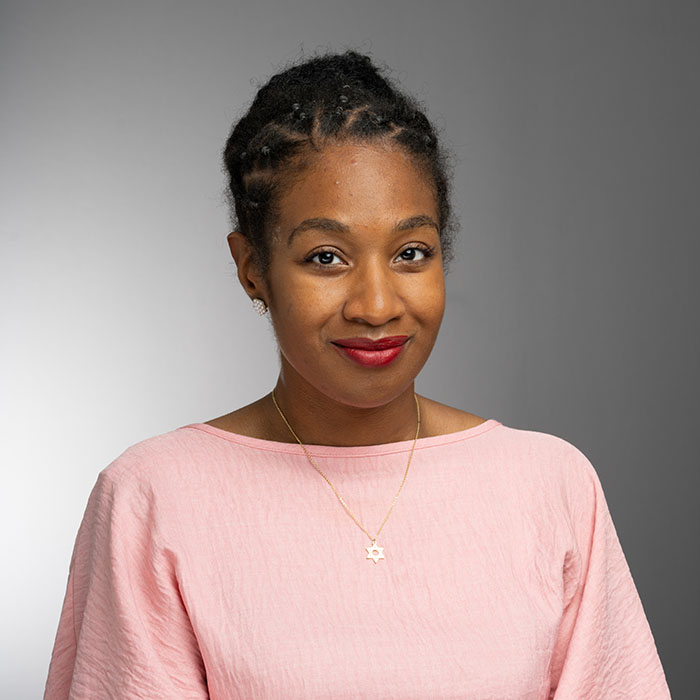
Michelle Erskine, Ph.D., CCC-SLP

Assistant Professor

Name

Contact Info

Phone:
Office:
Health Professions, 4140 V

Education

Ph.D., University of Maryland-College Park
M.S., University of Wisconsin-Madison
B.S., Long Island University Brookville

Areas of Expertise

-Language learning and literacy development
-Language variation
-Real-time spoken language processing

Select Publications

  • Maher, Z., Erskine, M. E., Byrd, A., Harring, J., & Edwards, J. (2021). African American English and early literacy: A comparison of approaches to quantifying nonmainstream dialect use. Language, Speech, and Hearing Services in Schools, 52(1), 118–130.
  • Cychosz, M., Erskine, M. E., Munson, B., & Edwards, J. (2020). A lexical advantage in four-year-old children’s word repetition. Journal of Child Language, 47(6), 1–24.
  • Erskine, M. E., Reidy, P., Munson, B., & Edwards, J. (2020). Relationship between explicit and implicit phonological awareness: Evidence from a longitudinal study on preschool children. Applied Psycholinguistics, 41(3), 1–29.

Select Presentations

  • Erskine, M. E., Borovsky, A., & Seidl, A. (2025, November 20–22). Shared interest leads to meaningful gains in vocabulary learning in school-age children [Conference presentation]. Annual American Speech-Language-Hearing Association Convention, Washington, DC.
  • Erskine, M. E., Huang, Y. T., & Edwards, J. E. (2023, June 1–3). Children’s comprehension of unfamiliar dialects is contingent on the speaker’s dialect use and social background [Conference presentation]. Symposium on Research in Child Language Development, Madison, WI.

Research

  1. Language Variation and Educational Outcomes — One arm of my research investigates how children navigate language variation in spoken English and how this variability influences language comprehension, vocabulary learning and literacy development. By examining the intersection of language variation and educational outcomes, my work seeks to understand language-related variables that shape children’s academic trajectories and to inform practices that better support diverse linguistic communities.
  2. Social Influences on Real-Time Language Learning — Another arm evaluates how children’s language learning (or word learning) is influenced by indexical properties of speakers (such as age or linguistic background) and by shared interests. Using eye-tracking and other real-time experimental methods, I examine how these social cues impact the process of acquiring new vocabulary.
  3. Socioeconomic Contexts and Language Risk — I also study how children’s socioeconomic backgrounds, and their intersections with risk for language disorders or literacy-related problems, shape language development. My work explores how differences in learning environments and patterns of language use contribute to variability in vocabulary growth and school readiness. A central aim of this research is to build bridges from experimental findings to applied contexts, informing both classroom instruction and clinical practice.

Certifications and Licensure

  • licensed speech-language pathologist
  • ASHA certification of clinical competency in speech-language pathology

Memberships and Affiliations

  • American Speech-Language-Hearing Association