Abby Song, Hanbok Designer
Spring 2016
Abby Song is a young Korean artist. She came to America when she was eleven years old. She studied painting at Maryland Institute College of Art (MICA). She is very interested in Korean traditional arts and she decided to study garments and design her own hanbok, a form of traditional Korean dress.
This interview with Abby Song was conducted by Towson University alumnus Elayna Daminabo in 2016 while enrolled in a special topics seminar, Asia in Maryland (AIM) Cultural History Project. The course combined ethnography and oral history to explore, understand and document Asian arts and culture in Maryland. The text below represents a transcript of Elayna’s interview, which has been edited for clarity.
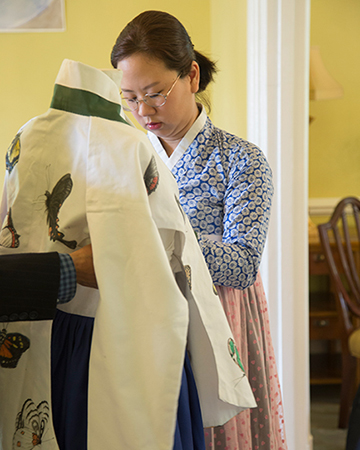
ED: Why did you begin designing hanbok?
AS: When I was young, I was very interested in traditional Korean art forms and in culture related to everyday life: architecture, clothing and food. I can’t really study architecture here and I wasn’t really interested in food. So I decided to study garments and I instantly got really into the subject. Then I started to design and wear what I made.
ED: When did you start designing exactly?
AS: I started blogging when I started designing and making hanbok. So I know the exact date because it’s written in my blog: October 2010. My blog is called Abby’s Hanbok. So straightforward [laughter]. It shows how and when I started, what the difficulties were, what I found on the internet and books, and my thoughts or philosophy about hanbok.
ED: What difficulties did you face?
AS: I wish I had a teacher to ask my questions. Even though I had questions about things, I couldn’t ask anybody to help me. They only sent emails like, “Go girl.” I needed feedback. Maybe one or two people helped me but there was a lack of studies on this topic. That’s why I wrote a blog, so people could help me. Anybody can access my blog.
ED: How often did you wear hanbok?
AS: When I was at MICA, I wore hanbok to my thesis class. After class, I wore hanbok everyday because I wanted to understand it. And the only way I could understand it was by wearing it. I was thinking, “Why am I designing and making this hanbok even though it’s pretty painful?” But it’s about accepting who I am in America and showing people I’m Korean. If I wear hanbok, it fits. It was designed for my body like my ancestors. I didn’t have to worry about if I looked good or not. It’s designed for me so I guess I felt pride.
ED: Did you notice stares?
AS: People asked me questions when I was in galleries, what I was wearing. They’re really interested in what I was wearing and they tried to take a picture of me without asking. I told them not to do that several times in the galleries. Yeah, I do get stares, even in Target and places like that.
ED: When did you move to America and how did you adjust?
AS: I moved here when I was eleven. I went to a Catholic high school. School helped me to adjust to a new life here. I went to UMBC to major in environmental science, but after studying that for two years I thought I wasn’t really interested. So I looked for other stuff that I was interested in, and I thought “Why don’t I go back to art? It’s in my background.” When I figured that out, I quit right away [laughs]. I dropped all the classes.
ED: Does your painting help you design hanbok?
AS: Hmmmm, right now I’m trying to paint abstract paintings that derive from hanbok design, but when I was at MICA, no. It’s very different from hanbok.
ED: How do you approach making the hanbok? What’s your design process? What inspires you?
AS: Since I am living in America, the design process has to fit this lifestyle. I am trying to change the design so that it’s more comfortable to wear in a café or in a car and so it’s not hard to explain. Not too Korean, way more westernized. I’m also trying more whites than colored fabrics because when I wash these garments, you have to be really careful. When I make everything white, it shortens the washing time and caring time. But it’s going to look like I’m wearing a wedding dress everywhere.
I am extremely excited about learning natural dying — using plants, flowers, seeds. You can dye fabric with dandelions, little yellow flowers found everywhere in the U.S. The color is yellowish green and it’s beautiful. The color looks more 3D than artificial colors. We used to dye fabric like that but we stopped because we have better artificial colors and you can dye stuff in 30 minutes.
ED: Isn’t that a lot of flowers?
AS: A lot of flowers — bags and bags. There is a specific portion you have to have. It’s all scientific actually. You boil flowers for 1-2 hours and let that sit overnight. So it takes a day. That’s why rich people could wear color back then. It requires a lot of labor and time. It’s actually really hard to learn by yourself because you have to do a lot of research. But I like the process. It’s fulfilling. It’s very different from artificial coloring.
ED: What designers have inspired you?
AS: When I started to study hanbok, I gathered a lot of photography and videos. Traditional Korean dancers really understand how the hanbok works on their bodies, how clothes work when moving. Design is so flat and I don’t know how to make hanbok professionally because nobody taught me how to do it. So I need to understand how it actually looks, how to make it more comfortable. I could compare photos with videos of dancers. That was like a teacher to me.
ED: I remember you telling me about an artist named Hye Soon Lee. How did her designs help you?
AS: In the 20th and early 21st century, designers used a lot of bright and deep colors but they didn’t really harmonize well. But Hye Soon Lee uses a lot of pastel colors and deep dark colors. It’s very different than other Korean hanbok designers. I was like, “Wow, we can use these colors on hanbok too.” That’s why she inspired me a lot, how she uses color.
ED: Do you think Korean artists like Hye Soon Lee help keep the tradition alive?
AS: I think so. Her work is in Korean Vogue fashion magazines, and people do like to look at hanbok. They just don’t want to wear it every day. It’s a reminder that we have our own traditional costume. It still looks beautiful even though it’s from 2,000 years ago.
ED: Do you think that the hanbok needs to be modernized?
AS: I think it has to be studied and advanced because our lifestyle has changed. We have to sit in a chair for a long time. Koreans, like other Asian countries like Japan and China, used to sit on the floor. That’s why the skirt is very long and full because you had to sit on the floor instead of a chair. Now we have a different lifestyle, we have to sadly change the length of the skirt.
ED: How do you think people should make hanbok more wearable but keep it traditional?
AS: If they wear hanbok every day and think about what needs to change, I think that’s going to advance the design. That’s going to make hanbok traditional but fit current everyday life.
The difference between the old ones and new ones is that we can use machines. I honestly don’t like that change. You can tell if you use machinery or sew by hand. Because when you wear it, it becomes 3D and you can definitely see the quality. That’s why I keep sewing by hand instead of using the sewing machine.
ED: So how long does it take to make a hanbok by hand?
AS: The bottom part actually took a week with my school work. I spent at least four hours a day. It took a week because it was a long skirt. I used at least 4 yards of fabric to make it fuller.
ED: What steps are you taking to keep the tradition alive?
AS: I can’t really buy what Koreans use for hanbok here so I’m going to continue using what I can find around me. I want to dye my clothes with natural dyes and make it from scratch. Everything from scratch. As an immigrant, everything is a new start. It’s very similar. It’s like trying to find myself from scratch. Because I don’t have a teacher. I have to be a leader for myself. I have to stay strong.
ED: How many hanboks have you made so far?
AS: I know I made a lot, like 30 or 40 pieces, including jewelry, hats, bags, and stuff like that. I made those in the early stages of my process, so when I look at them now, I feel the quality is terrible. It’s like when you’re young, you can’t even draw a straight line. But after you get to college and do some studies, you can draw a pretty straight line. I couldn’t get rid of those pieces then but I think I need to now.
ED: How much does it cost to make a hanbok versus buying one?
AS: It’s very cheap to make. You just need one needle, one roll of thread, a few yards of fabric. That’s going to cost you not even thirty bucks. It takes a lot of time to make. It could actually take a month to make it, from underwear to outerwear. I heard the designers in Korea actually ask you for 3,000 to 4.000, but they make underwear and the socks and outwear as a set, and with ornaments also.
ED: What are the steps in making the hanbok?
AS: I’m not a professionally trained designer so I can’t really tell you the way to make hanbok. There’s no evidence that the design was like this or like that. Every design was different. The weather in North Korea and South Korea is a little different so people wore different fabrics. That means sewing techniques are a little different from north and south, west and east. Koreans are still studying this part, so sadly we can’t really compare if you’re doing it the right way or wrong way.
But it’s very similar to other clothing design steps. You draw the shapes on paper first then cut out the paper. Then you draw on top of the textile. It’s very similar to western or any other design processes.
ED: Can you explain the layers of hanbok?
AS: Most people wore at least two layers underneath the very top part of the hanbok, but the higher class people wore at least four layers underneath. Most people then were not that healthy. They were thin and they thought wearing more stuff on top makes you more noble. More textiles also show that you are rich because you have more fabric than other people. But that changed a little bit after the war.
This top part is pretty important in hanbok history. There aren’t many books about the top part but I have a book, “Beautiful Cheogori,” which is the top part of the hanbok. The skirt didn’t really change but the top part did. Scholars usually say Koreans have at least a 2,000 year long history of hanbok. So 2,000 years ago, the hanbok was actually long and big. During wartime, the top got smaller and shorter because you need to survive. There’s no time to make it big. In the 18th-19th centuries, ladies’ tops became shorter and shorter until they couldn’t cover the breasts. They had to wear some kind of cover. That’s why we had underwear that doesn’t look like a bra but it covers your breasts.
ED: What do the colors of hanbok represent?
AS: I know that red skirts represent a virgin who is not married yet. A yellow top and red skirt means you’re not married and you’re expecting a husband. A blue skirt means you have a son. I’m still studying this subject. I’m very interested in understanding how color represents status. I guess if you’re wearing a lot of color, you’re rich, because back then dying fabric takes a lot of skill and time. Americans who went to Korea in the 19th or 20th centuries saw everybody in white when they went to markets, where many people were playing and talking, like here at the mall.
ED: How is the hair worn when wearing a hanbok?
AS: I think right now people do not really care about hairstyles, but I believe that hanbok design was developed with hairstyles in mind. When I wear hanbok I tie my hair really tight. I use mousse or gel. I don’t really want my hair puffy [laughs]. I prefer my hair very neat and sleek.
ED: What are the differences between hanbok for men versus women?
AS: The big difference is that men wear pants and women wear skirts. Underneath they are wearing pant-looking underwear. I believe women wore more layers of hanbok than men, especially the bottom part. Koreans believe that men have to wear less layers for their bottoms, and it’s opposite for women. The bottom part has to be warmer than the top part for better health.
ED: You know all the facts [laughs].
AS: Because I’m interested in scientific parts of hanbok, too, like why it’s healthier than skinny jeans. The clothing is more breathable and the circulation is better when you wear hanbok than when you wear skinny jeans and bras that tighten you.
ED: Do you think American clothing was an influence?
AS: In my opinion, it was the Japanese who changed everything during the war. They forced us to use Japanese for everyday language. They said no hanbok, no wearing white. They regulated everything — education, culture. They told us what to do, what to wear, what to use. Then Americans came. It’s very sad.
ES: When are hanboks usually worn? How do traditional ways compare to today?
AS: In the 19th century there was a mixture of hanbok and western style dress. Currently people wear hanbok on special occasions — for birthdays, weddings, funerals. In the 1990s or early 2000s, I read articles in Korean news channels, and they said younger people were starting to wear hanbok for dates and for ordinary events like going to a café. In six years, a lot of things changed. When I started to study hanbok in 2010 not many people were interested [laughter].
ED: What you’re trying to do is make it more convenient so people can wear it everyday.
AS: Yeah. You don’t have to wear layers and layers on top, so it can be more convenient. But if you don’t wear undergarments it will look very different. That’s the sad part. It looks like you’re not wearing your garments. There’s a weird space. I try to use at least one layer underneath the outer wear.
ED: You said you never sell hanbok. Why?
AS: Actually a few people asked me to make their hanbok. But I said no because I still need to learn how to make it. Maybe in 30 years [laughter].
ED: Does your mom know anything about hanbok? Does she help you out?
AS: She used to get worried because I was doing something different than other Korean immigrants. But I’m pretty talented. I can do anything with my hands. It took a lot of time to let her know that I want to be an artist. Right now she supports me.
ED: You should make her a hanbok one day.
AS: I would love to make mom something actually. I know their body, their favorite color, and what their favorite designs are. That’s why I was saying “no, maybe later” to other people who ask me to make hanbok for them because I did not understand their personality, their style. That’s not sincere.
ED: So would you showcase the art of your hanbok?
AS: In a gallery. Anything that I make now I want to present as artwork. I’m going to dye naturally so I can have my own color for hanbok.
I am very interested in East Asian humanities and philosophy because it overlaps with what I am interested in. It explains what’s been happening alongside the clothing culture. It helps if I study something that could help what I’m doing right now as an artist and as a designer.
ED: What does the hanbok mean to you?
AS: It represents my identity. I don’t have to worry about if I look good or bad. The garment controls the movements I make, so that changes my thoughts also. I really like that. I really like that clothes can change my way of thinking. That’s why I really like to make and design hanbok and wear them. In any culture in any country, clothes can represent you and control everything — your body, your mind, even your philosophy. It’s not just hanbok, it’s what you're wearing.
ED: So are you going to start making hanbok again?
AS: I will get a promotion very soon, in about two months. That’s very important in my life also. So I have to get used to my new job and my position. After that, maybe in six months, I really want to make hanbok.
About the Research and Researcher: Elayna Daminabo
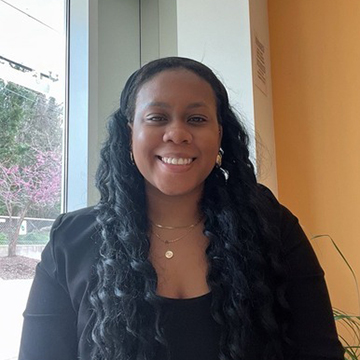
Elayna Daminabo is a community engagement and events professional whose work explores the intersection of culture, identity, and shared experience. Based in Washington, D.C., Daminabo designs and leads programs that foster connection across diverse communities, creating intentional, inclusive experiences through events, marketing, and outreach.
Elayna graduated from Towson University in 2017. In Spring 2016, she was enrolled in a Towson University special topics seminar, Asia in Maryland (AIM) Cultural History Project, which was team-taught by Joanna Pecore, Director of Asian Arts and Culture Center, and Stacy Spaulding, Associate Professor of Journalism and New Media. Elayna's interview with hanbok designer Abby Song shaped her perspective on how heritage evolves through modern expression.
Note: The author's bio was added in May 2026.