Research Opportunities
A wide variety of graduate and undergraduate research experiences are available to our students.
Research in Biology
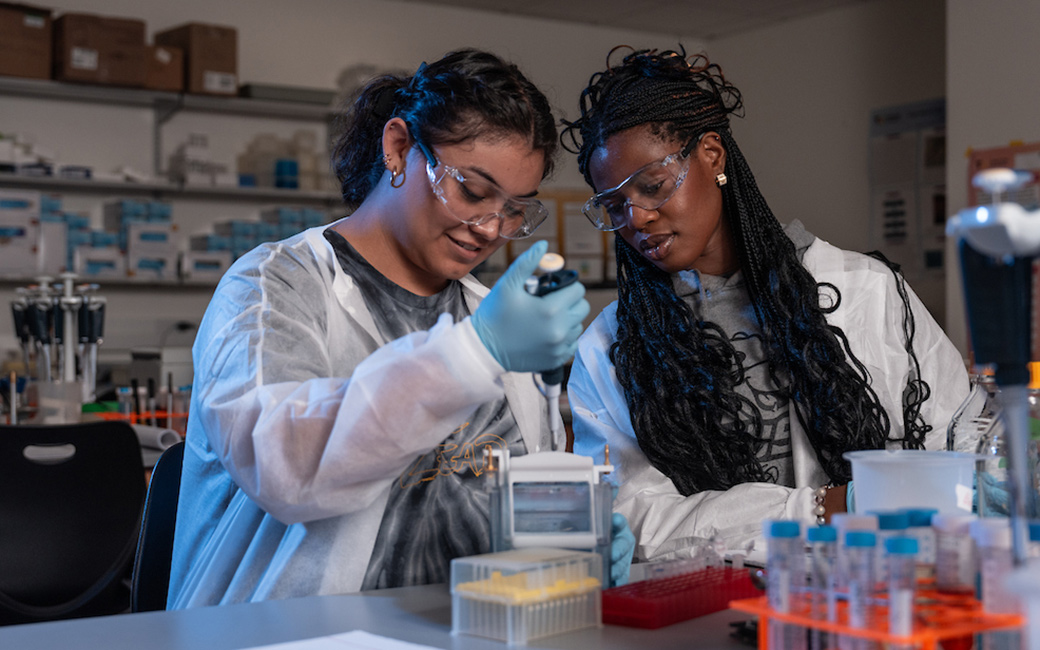
By working with a biology faculty member, students immerse themselves in real scientific investigation, learning to solve problems, think critically and approach data with a researcher’s mindset. Whether you’re a graduate or undergraduate student, the first step to getting involved in research is finding a research mentor. Use the table below to find your research and faculty actively recruiting:
| Faculty | Research Area | Actively Recruiting Undergrads? | Actively Recruiting grads? |
|---|---|---|---|
| Dr. Nicole Barbour | Movement ecology, wildlife science, animal behavior, spatial ecology | Yes | No |
| Dr. Vanessa Beauchamp | Plant ecology, forest succession, stream restoration, invasive plants | No | No |
| Dr. Alice Besterman | Coastal ecology, avian ecology, wetlands, restoration | Yes | Yes |
| Dr. Mark Bulmer | Social insect and pathogens | Yes | Yes |
| Dr. Daniel Caetano | Phylogenetics, macroevolution, phylogenetic comparative methods | No | No |
| Dr. Renee Dickie | Regeneration, wound healing, angiogenesis | No | No |
| Dr. Jacqueline Doyle | Conservation genomics | No | No |
| Dr. Elana Ehrlich | Virology, cell biology, cancer biology, host-pathogen interactions | No | No |
| Dr. Anne Estes | Host-microbe interactions, bacterial genomics | No | No |
| Dr. Carmen Falcone | Neurobiology, glial biology, evolutionary developmental neuroscience | Yes | Yes |
| Dr. Brian Fath | Ecosystem ecology, network analysis, sustainability and resilience | Yes | Yes |
| Dr. Laura Gough | Plant ecology, mentoring | No | No |
| Dr. Sarah Haines | Science and environmental education | Yes | Yes |
| Dr. Erin Harberts | Immunology, host-pathogen interactions | No | Yes |
|
Molecular biology of small proteins in bacteria |
Yes |
No |
|
| Dr. Iskander Ibrahim | Molecular mechanisms of photosynthesis and plant responses to abiotic stress | Yes | Yes |
| Dr. Steve Kimble | Conservation genetics, herpetology, microbiomes | Yes | Yes |
| Dr. Krista Kraskura | Fish physiology, animal physiology and conservation physiology | No | No |
| Dr. John LaPolla | Ant systematics, ant-mealybug symbiosis, ant taxonomy and paleontology | Yes | Yes |
| Dr. Sarah Longo | Functional morphology, evolution and biomechanics | No | No |
| Dr. Christopher Oufiero | Evolutionary physiology, functional morphology | Yes | Yes |
| Dr. Katherine Sayers | Neuropharmacology | No | No |
| Dr. Vonnie Shields | Chemosensory and visual biology | Yes | Yes |
| Dr. Kishana Taylor | Virology, infectious diseases | Yes | Yes |
| Dr. Peko Tsuji | Colon cancer and inflammation | No | Yes |
| Dr. Crystal Uminski | Biology education | Yes | Yes |
| Dr. John Wedon | Molecular biology and biochemistry, protein engineering | Yes | Yes |
Graduate students have two tracks for their degree requirements:
Thesis students must select a mentor before they apply for the biology program, so be sure to research potential mentors long before the application deadline. See the biology graduate page for more details. Non-thesis students do not have a research requirement yet many non-thesis students engage in research.
Course-Based Undergraduate Research Experience
In addition to directly working in a mentor’s lab, students can gain research experience through coursework. Specifically, CURE (course based undergraduate research experience) courses can be a way to earn both credit toward your degree and be involved in authentic research. For details visit:
Scholarships, Grants and Awards
Student research activities are often supported by scholarships, grants and awards. Not only can applying for these help fund student research efforts, but the application process itself can help build skills in how scientists go about procuring funds to conduct research. There are a number of funding opportunities available within the department.