
Explore Career Competencies
Degree Boosts build in-demand career ready skills.
Develop skills and connections inside and outside of the classroom designed to level up your degree and impact you for life.

What will set you apart from all those other students earning degrees? By participating in Degree Boost experiences, you will stand out and gain a competitive advantage in securing jobs, scholarships and graduate school admissions.
TU provides hundreds of options to boost your degree, including many that are automatically built into your experience as a Tiger. Take control of your future by maximizing your participation in Degree Boost opportunities built into the TU experience and proactively choosing Boosts to prepare yourself for the next step in your career, education and life.
By boosting your degree, you will:
Academic research and creative inquiry are part of every academic discipline at Towson University. Students who have participated in undergraduate research consistently rate these experiences as among the most valuable of their college career.
Faculty-mentored research allows you to explore a topic or area in more depth and to refine your academic and intellectual interests. Some students take on projects outside of their major field while others opt to challenge themselves with projects related to their major or career interests.
Students can begin undergraduate research and creative inquiry activities as early as their first semester on campus.
College-specific research opportunities include:
Get ready to take the educational journey of a lifetime. Join the hundreds of TU students who study abroad or away each year — for a summer, minimester, spring break, semester or full academic year. Apply for an internship abroad, full time or combined with regular classes, and gain real world experience in a global setting.
Studies have shown that study abroad and away has a long-term positive impact on a student's personal, professional and academic life and can directly influence their career path, world-view and self-confidence.
TU students who study abroad or away are more likely to complete their degree and graduate faster and with a higher GPA than their peers who do not have a study abroad or away experience.
From California to North Dakota and Ghana to the Czech Republic, TU students are discovering new places, exploring new cultures and broadening their view of the world. Acquire cross-cultural skills, observe how your academic field is studied and practiced elsewhere and enhance your prospects in today's dynamic work field.
Participants gain:
Contact Study Abroad and Away to learn more about the hundreds of opportunities available to TU students through Faculty-Led Programs, Exchanges, TU Programs, and Approved Non-TU Programs.
Living Learning Communities (LLCs) offer more than just a place to live—they connect first-year students with faculty, staff and peers who share their academic and personal interests, deepening senses of belonging at TU.
LLCs offer specialized programming and collaborative support from Residence Life and academic partners, and many include linked courses where residents learn alongside neighbors. These communities help students build connections, engage deeply in their interests and succeed academically—all in a supportive, small environment with no additional cost.
As part of the housing application, first-year students will be able to select LLC preferences and complete any supplemental questions for up to three communities of interest.
Participating in community-based learning increases your awareness of your campus, local and global communities, helps you understand the impact of policies on communities and prepares you to meaningfully shape your communities. Explore real-world issues and engage in learning through experience and reflection.
Community-engaged learning can help develop skills and knowledge in:
Find social impact programs and leadership opportunities. Look for community engaged learning courses to enroll in.
Honors College students can apply to present their upper-level Service-Learning courses towards their Honors requirements.
Internships give you real-world experience that goes beyond the classroom, helping you apply what you’ve learned in a professional setting. They allow you to build valuable skills, expand your network, explore potential career paths and in many cases receive credit and/or pay. Participating in an internship can set you apart in a competitive job market and give you the confidence to launch your career successfully.
Learn more about internships and experiential learning or find the internship coordinator for your college.
Honors College students can apply to count their internships courses towards their Honors requirements.
Working in an on-campus job offers more than just a paycheck—it connects you with mentors, builds career-ready skills and deepens your sense of belonging in the TU community. Campus employment can help you build your resume, grow professionally, and reinforce your academic and career goals in a supportive environment. Student employment fosters meaningful interactions, real-world problem-solving and reflective learning.
Learn more about on campus jobs or find job openings on Handshake.
On-campus jobs include:
Leadership integrates self-development, strengths, personal values and diverse perspectives to cultivate critical thinking and effective decision-making. Leaders foster relationships, embrace challenges, innovate and advocate while promoting integrity, wellbeing and sustainable community-based change.
Student leadership experiences at TU are designed to help you become an engaged and self-aware student who possesses the skills necessary to create positive change not only in the TU community, but in the greater global community as well. TU is an ideal setting for you to grow as an individual and leader.
Experiences like Tigers Lead, a three-phase certificate leadership development program, guide students in discovering themselves as a leader through interactive workshops, hands-on experiences and community building.
Becoming a peer coach is an opportunity to make a real impact by helping fellow students succeed at TU. As a peer coach, you will gain leadership, communication and mentoring skills that employers value, all while building meaningful connections on campus. Serving as a peer coach not only strengthens your resume but also gives you the chance to grow as a leader and role model within the community.
There are many opportunities to become a peer coach at TU. A small sample is listed below. Many peer coaching positions will be posted in Handshake.
TSEM offers small, faculty-led seminars to introduce students to rigorous academic expectations while building essential competencies in critical thinking, research, writing, and collaboration. With topics spanning disciplines from history and public policy to environmental science and financial literacy, TSEM courses engage students in research and analysis that align with their interests.
Faculty work closely with students throughout the semester, providing meaningful feedback and mentorship that supports intellectual development and academic confidence.
All first-year students are required to take TSEM 102 and are assigned a First Year Experience (FYE) Advisor to guide them through their first year. Both of these touchpoints are a good way to get connected to future opportunities.
Enroll in a course with an embedded Writing Fellow.
Common Intellectual Experiences (CIEs) are often structured experiences that bring groups of students together around shared themes, questions, texts, or problems. CIEs foster shared learning, intellectual engagement, and a sense of academic community, often serving as a foundation for deeper engagement in college, especially in the first year, but can be implemented at any stage of your academic journey.
CIEs typically:
While not formalized at TU, there are many ways to get engaged in CIEs.
Towson University students take at least two writing intensive courses during their undergraduate experience. Writing-intensive courses have been shown to help students develop deeper engagement with course content. Students gain a better understanding of their writing process and how to produce professional-level documents in their disciplines. Employers have often pointed to these skills as the most critical for students to develop and the ones that new employees struggle the most with.
First-year students enroll in English 102 (Writing for a Liberal Education), which introduces students to college-level academic writing. Students read and analyze challenging texts, synthesize ideas from those texts with the writer’s own ideas, and communicate those ideas appropriately to different audiences.
In addition, upper division students enroll in at least one advanced writing seminar. These classes are usually very small (<25 students) and aim to develop students’ writing skills inside their academic disciplines. Students learn to produce genres specific to that discipline (lesson plans for education students, case studies in economics, etc.). They also learn how to evaluate evidence in that discipline as well as how to follow the conventions in that field.
Enroll in a course with an embedded Writing Fellow.
Contact The Writing Center to learn more about writing-intensive courses and to develop your written communication skills.
Collaborative assignments and projects combine social, psychological, and academic benefits including professional skill development (teamwork, communication, problem-solving and critical thinking) and perspective diversity (exposure to different backgrounds, life experiences and disciplinary viewpoints).
Seek out and fully engage in course elements such as in-course study groups for peer learning, team-based projects in design or research, cross-disciplinary collaborations and community engagement projects that address community needs.
ePortfolios enable you to electronically collect your work over time, reflect upon your personal and academic growth and share selected items with others. An ePortfolio helps you prove and showcase your skills, experiences and development in a polished, professional format that goes far beyond a résumé. It also encourages deeper reflection on your learning, making your college experience more meaningful and helping you communicate your story confidently to employers and/or graduate programs.
Seek out and fully engage in course elements such as in-course study groups for peer learning, team-based projects in design or research, cross-disciplinary collaborations and community engagement projects that address community needs.
These culminating academic experiences are taken by students nearing the end of their programs. They require students to synthesize, integrate and apply knowledge, skills and competencies gained throughout their studies into a single, meaningful project or set of projects. In some cases, capstone projects are used to demonstrate readiness to enter into a given career. These can be transformative experiences as they allow you to assess your own perspective, attitudes and values in relation to the skills and knowledge you have obtained.
Connect with your academic department to learn more about a required or optional capstone course and/or senior seminar.
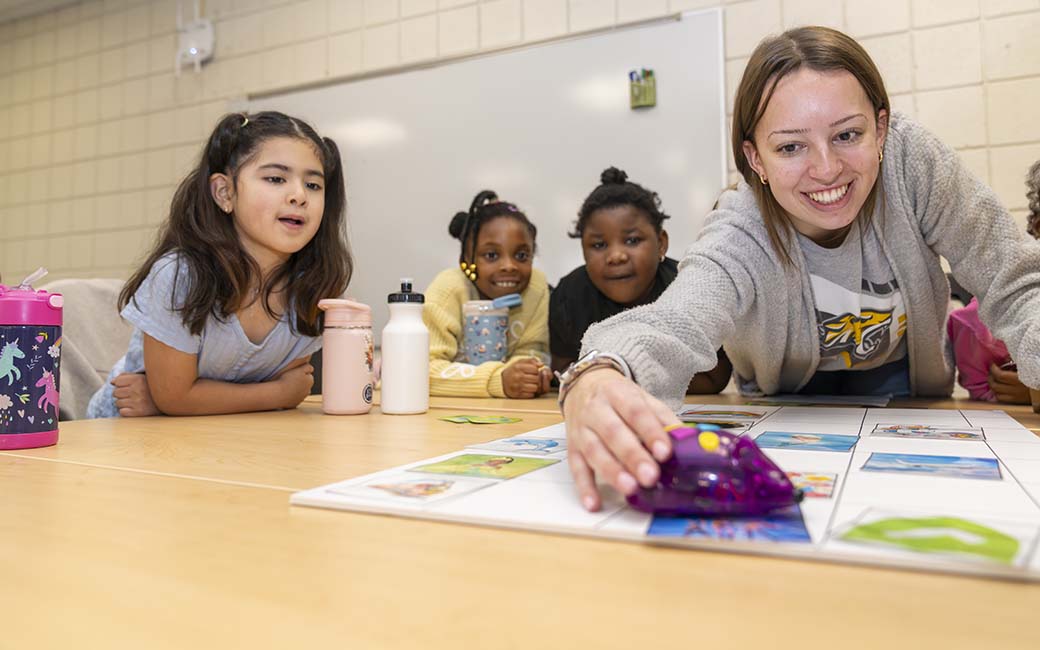
How a campus and community program is helping kids from across the area learn more about computing, artificial intelligence and cybersecurity.
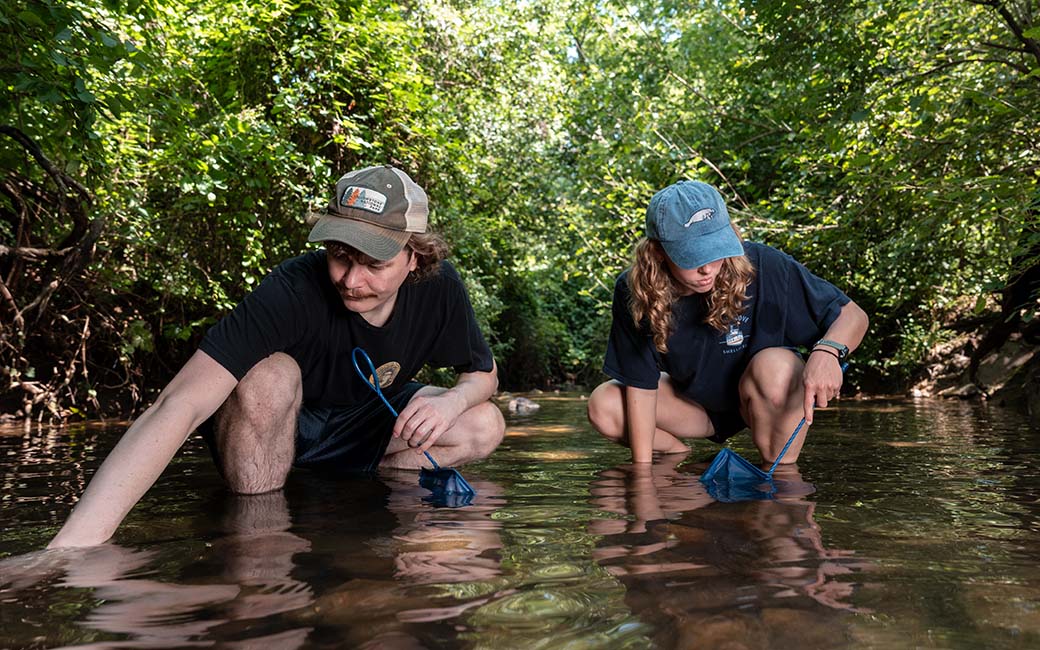
TU students get real-life field work experience by studying crayfish in Maryland’s freshwater streams.
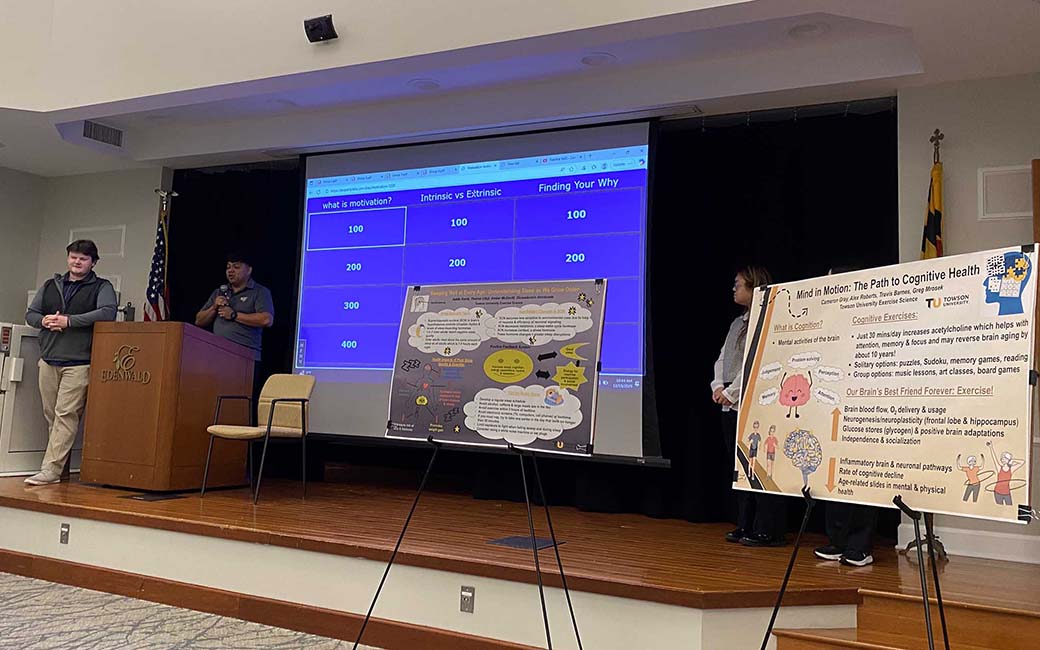
CHP professor Andrea Barton uses experiential learning to help local older adults.